
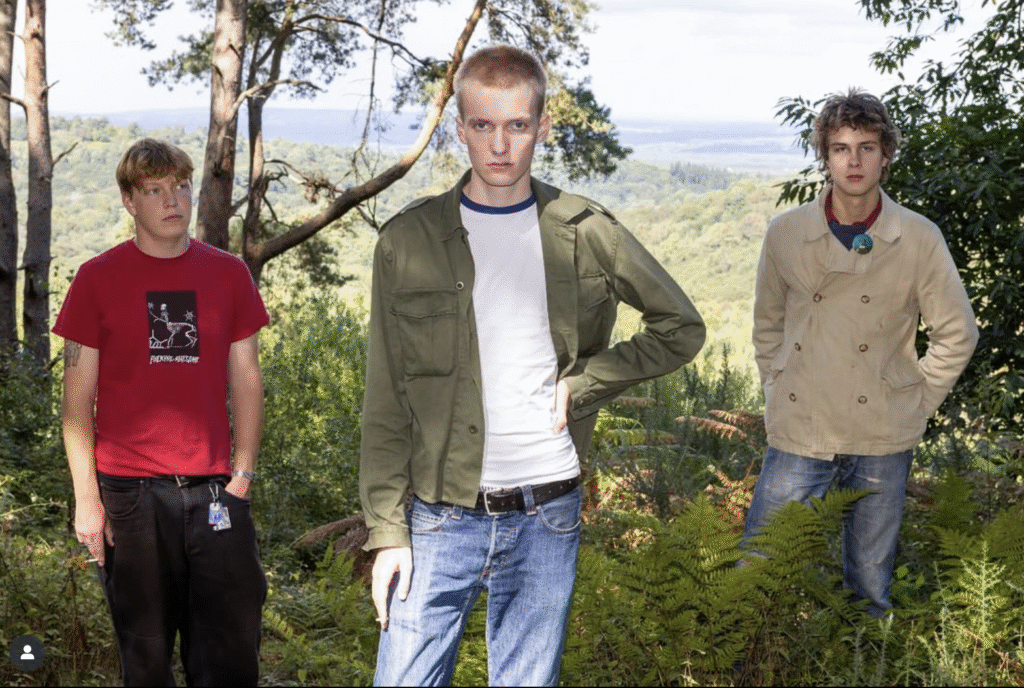
What’s the best thing about playing live? I ask Uncle Junior, the eccentric teenage London three-piece. The answer comes quickly: “The rider.” Bassist Eric Lees reaches for Jack White’s mini-fridge and produces cans of the star’s own-brand beer. “Speaking of…” he says, handing them round. We’re in the swanky Soho green room of Jack White’s Third Man Records, where we join Oli Noble (vocalist/guitarist), Isaac West (drummer) and Eric Lees (bassist) to discuss everything from their early days playing in bands together at school and collaborating with The Strokes’ producer to exploring right-wing American culture in their writing.
It’s Eric’s first show with Uncle Junior, and he admits to being “a bit nervous but mostly excited” – a feeling shared by the rest of the band, who note it’s their first gig in “two and a half months… long time.” That run ends now, with several shows lined up, including a Palestine fundraiser at the 100 Club next week, headlined by Man/Woman/Chainsaw – not their first time sharing a bill with the fellow noisy Londoners. “We played with them in May for So Young at the Elephant’s Head,” says Oli. “But I think that was the only other time…” Isaac quickly corrects him: “And Dublin Castle. Three times. We also played with them at the Windmill twice for Bruno’s. Five times!”
That sense of connection with other musicians is vital, they say. Oli notes that “we played our first gig off the back of some people we already knew, and then it just snowballed. If people didn’t talk to each other about the kind of music they were making, it would have been completely impossible – we’d have hit a wall after the first show. I couldn’t speak highly enough of how essential it is.”
Being part of that Windmill scene inevitably brings ‘London post-punk’ categorisation and comparisons to the likes of black midi, so I ask how they feel about these labels. “We’re not as against it as a lot of people are,” Oli says. “The people who are most against it are often the ones who feel threatened by the label because they’re very derivative of those bands. If you lean into it, it actually gives you room to grow.” Drummer Isaac adds: “It’s not like we’re rejecting it – that was an early influence on us. I remember watching the Black Midi Mercury Prize performance on TV with Oli and us both feeling really inspired. Some of our earlier stuff was definitely more influenced by them and made us want to play up in London, at the Windmill and such. But once we realised how oversaturated that scene was, we decided to bring in some of our other influences.”
Uncle Junior met at school, at least two of them long before bassist Eric joined. “Oli was in year eight, I was in year seven,” says the drummer. “We met in the music block at Bohunt Secondary and started talking about Lemmy and Motörhead, because I was a real metalhead back then, the whole Iron Maiden patch jacket and all that. I still love a lot of those bands, but I’m not really repping that kind of drip anymore.”
“I used to just go play drums in the music block at lunchtime because I was a bit of a loser in year eight,” Isaac recalls. “Oli was a loser too, so he was in there playing bass. We started jamming, then formed a hardcore band inspired by ’80s hardcore punk. My favourite bands still are Bad Brains and Void. We had one song called Riot – it was really bad. I had just hit puberty; it sounded like someone strangling a cat. But it was cute.” Oli adds: “It was very helpful in shaping this band. Playing together for so long means we’re comfortable sharing ideas. I’m never afraid to bring something up, and we rarely argue – that’s probably a result of having played together since I was 11.”
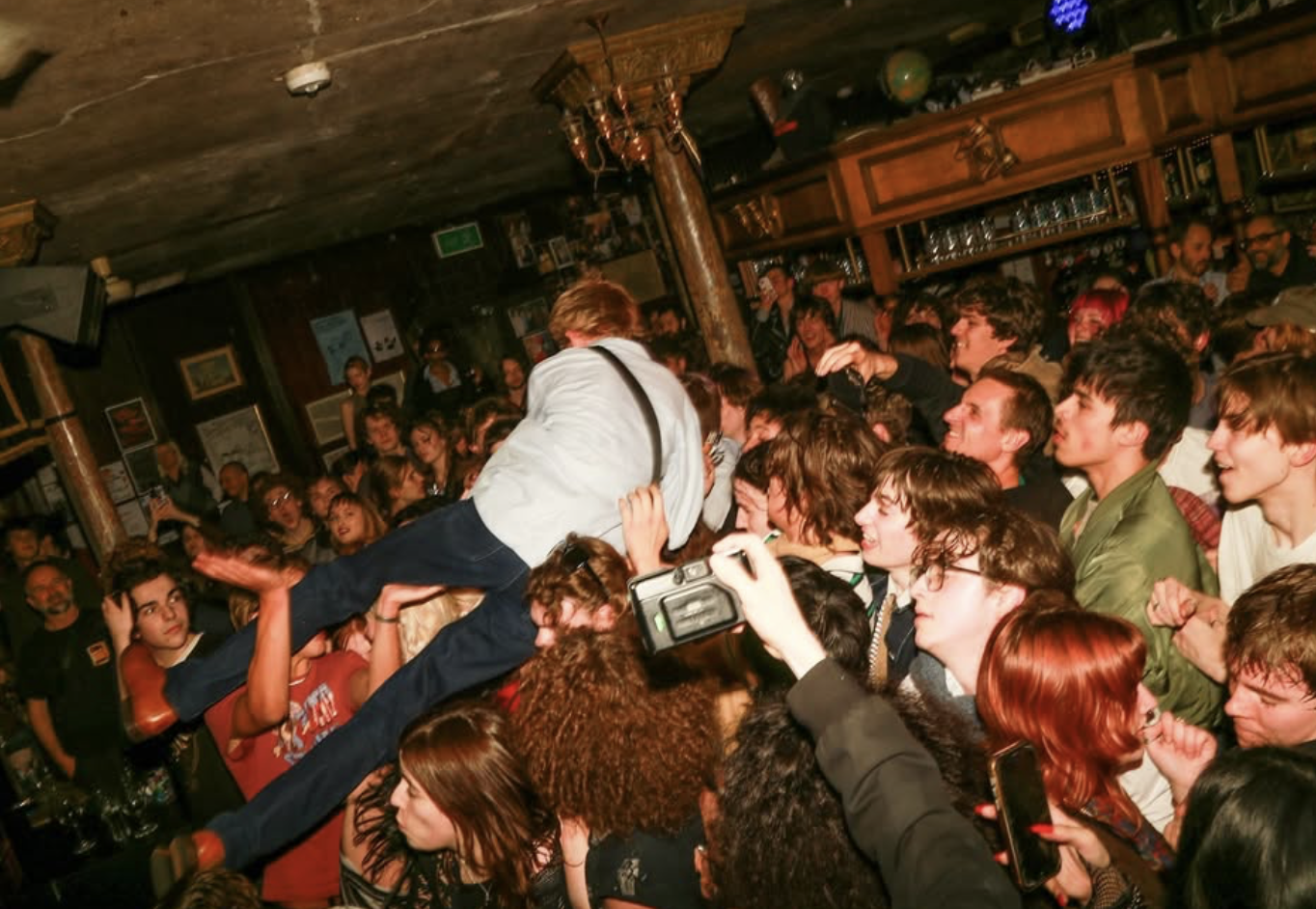
They must have tried plenty of other projects since their Bohunt days, so I ask when Uncle Junior clicked and became more than a hobby. Oli explains: “I feel like that’s two different answers. The project clicked and we found the name when we were 14 – it was just me and Isaac, and once we had something to call it, we started taking it more seriously. You can talk about it with other people, brag a bit – it’s a nice catalyst.” He continues: “But it really felt like something we wanted to pursue when we got bumped up the bill at the George Tavern and ended up headlining when we really shouldn’t have. That was July, two years ago. The room was packed, the energy was great, people were really enjoying it. From then on, we’ve been quite tunnel vision with it.”
The band worked with Gordon Raphael, producer of The Strokes’ first two albums, for their only two released singles, and Eric explains how it came about. “An author called Dave Thompson, the goat, came to a George Tavern show and knew Gordon from the early ’90s in Seattle. Dave used to hang out at Gordon’s flat, interview his band, and they stayed in touch. He told Gordon about us, put us in contact, and it went from there.” Oli adds: “He was quite a passive producer. We’d been working on the material for over three years, so the songs were already fleshed out – he didn’t need to put in much input.” Isaac laughs: “I liked that we’d do a take and he’d just say, ‘Yeah, good. It’s your record, man.’ Sometimes I wondered if he actually liked it or hated it, but he was great. And recording in that cool ass studio in Tottenham was great – I felt like Dr. Dre, loads of sick equipment.”
The band have a new EP out soon, Bethleham PA, much of which explores the stranger side of American culture. I ask what draws them to that, and whether it’s inspired by the current wave of far-right extremism across the pond. Oli nods: “Yeah, it most definitely was heavily inspired by that. It’s impossible to look at your phone or turn on the news without feeling the impact. But also, with songwriting, I got a bit fed up with bands that were overwhelmingly British – and the same with overwhelmingly American. Finding a middle ground with where rock music was going seemed like an interesting angle, something that would make the music more relatable. It’s still interesting for a British audience to explore from a British perspective, and more relatable for an American audience too.”
The EP leans heavily into humour and absurdity, with the band avoiding taking themselves too seriously. Isaac laughs: “When we were 15, I took myself very seriously – drummer in a band, had to be cool. I used to make a conscious effort not to smile on stage. I was a real bitch about it. Then I matured and thought, that shit’s so whack. There are so many people in the industry who think they’re the shit just because their band gets a bit of attention. It’s just unnecessary, just fuck around and have fun. Why wouldn’t you want to have fun?”
They might have built a cult following and have an EP on the way, but Uncle Junior are still very young: Oli is 18, while Isaac and Eric are 19, though they joke Isaac is “unc status” since he turns 20 next month. Do they see their age as an advantage or drawback? Oli is confident: “Advantage from day one. Sometimes older people are really horrible to us, bitter, and it’s obvious. You get some 25-year-old on the same bill as us, and when someone shows that kind of anger, it’s a good sign you’re doing something right to be making them scared. And they look like a massive bitch.” Isaac adds: “Now that we’re all 18, it’s a massive advantage. Before, it was a drawback – getting kicked out of venues. Our first gig we had to leave before seven; doors were at four, we played at three. Man/Woman/Chainsaw weren’t 18 yet either, so they got kicked out with us.”
After years of lunchtime rehearsals and early gigs, I ask Uncle Junior what success looks like to them. “Success to me is if I can play music and live off it,” Isaac says. “I don’t care about fame or clicks. If I can make enough to live off music and be happy, then yeah, I’m set. I’m here to have fun and play with my homies.” Oli adds, “I’m going to consider myself a failure until I have a wall of Vox amps.”
Words: Donovan Livesey