
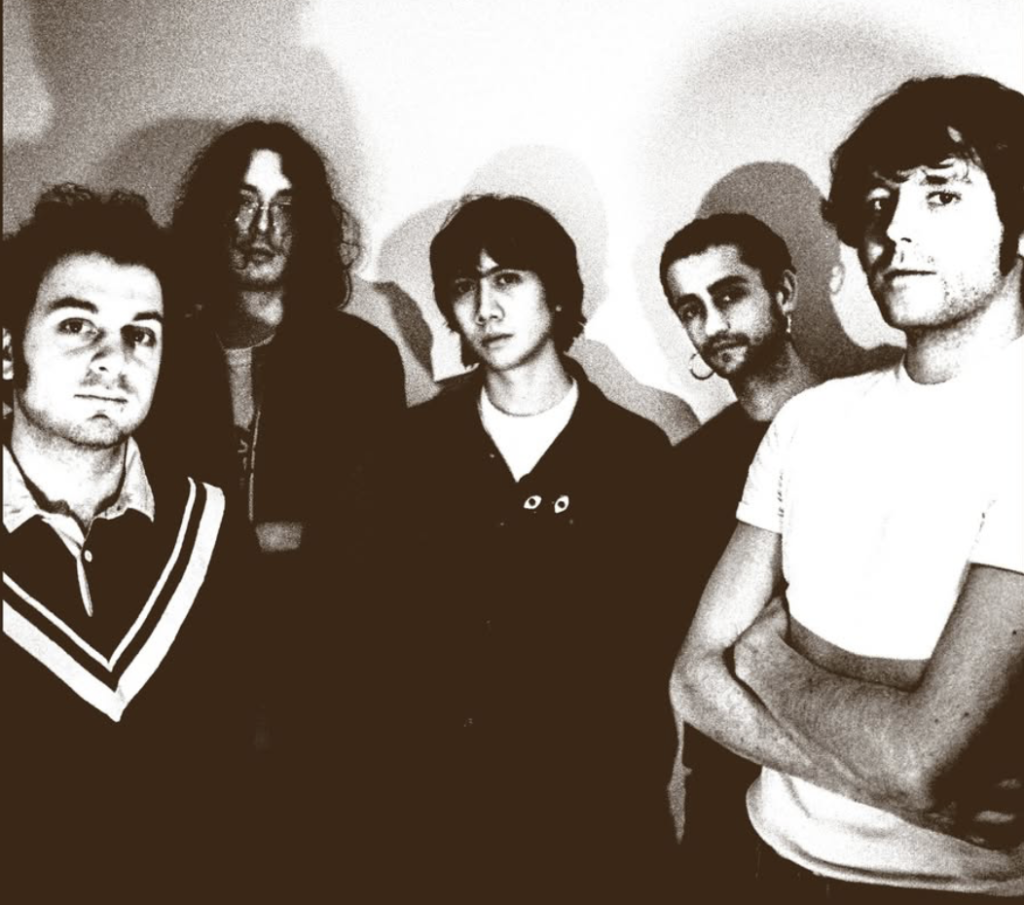
Spanish Horses, a forward-thinking rock’n’roll five-piece formed in Paris in 2023, moved to London last year and almost instantly became a scene favourite, praised for pushing the boundaries of contemporary rock while staying rooted in the melodies that make the genre so good. But they’ve since found success beyond the capital, and are currently on their first UK headline tour, and we caught the band (Tom Onezime on vocals and guitar, Albert Cocker on guitar, Victor Michee on bass, Cyril Stephan on drums, and Spike Davis-Yuille on keys and harmonica) on one of the opening dates to talk about everything from the differences between the Paris and London scenes to the perks of home recording and playing End of the Road festival.
You’re currently on your first UK headline tour, how has it been so far?
Tom: We’ve had a few hiccups along the road. Only technical for now.
Victor: And physical. And spiritual.
Tom: I feel like we’ve gone through the hardships and now it’s only going up hopefully. It feels very good to do this tour, we’ve arranged it ourselves and been super organised about it. I was a bit pre-emptive before – I was like, ‘what’s going to go wrong?’ And all the things that could have gone wrong have done.
Albert: At least it happened at the start and not at the end when we all hated each other. Nothing worse can happen now.
Tom: For me, it’s the happiest that I’ve been on tour.
It’s quite a busy one, you’ve got 12 shows in the space of two weeks. How are you adjusting to that schedule?
Spike: The first day was tough, we were all bundled into one tiny little front room. The sleeping situation can sort of make or break the next day, but we’re all always pretty tired after a gig so we sleep well and it’s okay.
Victor: I think it’s good now, we’ve adjusted pretty well. We’re used to dire situations, and we spend a lot of time with each other anyway.
You’ve got a new single out in a couple of weeks on the 20th of February. What can you tell us about that track?
Tom: It was written in the summer and we recorded it in the winter.
Albert: We just did it in two days with the band, we recorded it at home where we practice. We’ve got a little setup going where we’ve got some mics and a few Zoom mixers. We’re really happy with how it’s turned out, it’s a bit different to what we released prior.
Victor: It’s very particular and unusual in how it sounds in the production.
Spike: You finally got to play your double bass on it as well.
Albert: We’re enjoying home recording a lot, before we’d go to the studio and just capture what was going on live, but now we’re learning more about production and painting the tracks. It’s more freedom as well at home, you’re not stuck with a time limit as you are in studios so it’s a bit more time to experiment.
Cyril: Even when we record at home, we don’t get stuck in that trap of working on everything for days. We’re pretty good with how we want the song to sound so we don’t get stuck in this loop of it taking us two weeks to make a song at home because we’ve got loads of time. We still get it done.
Is the single going to be part of an EP or album, have you got any plans for that?
Tom: Don’t think so. We’re thinking of maybe recording an EP, but we don’t know. We don’t have any labels or anything so, for us, the thing that makes the most sense is releasing singles and keep the momentum going.
You were announced for End of the Road a couple of days ago. How did you feel when you found out?
Tom: Very happy. We got an email from two festivals in one day, we can’t talk about the other one but it was a good moment. That was a very positive week. I’m super excited.
Are there any bands on the bill you’re looking forward to seeing?
Tom: I’d like to see Bassvictim and RIP Magic.
Albert: I’m looking forward to seeing Femur. Adult DVD are on it as well, I haven’t heard any of their music but everyone in London has been telling us to catch them. We played at the same festival in Bedford but we didn’t have time to catch them, we had to leave early. Everyone’s been singing praise of them, I’m really excited to see them.
You’re obviously from Paris, but you’ve moved around a lot beyond there too. I read that Cyril’s lived in Dubai, Holland, Portugal-
Cyril: How did you know this?
Victor: Didn’t know we were with the FBI.
Tom: I met Tom in Dubai when I was 11, then I met Lorenzo when I was 12 and Victor when I was 15. All in Dubai.
Albert: I met these guys later on, about four years ago when they were all living in Paris. We met Spike there as well, we were all in different bands, but we shared the same stage a lot. We kept in contact. When we moved over here, we’d always been wanting a keyboard player.
Tom: A multi-instrumentalist. An ace of all trade, if you will.
Spike: Master of none.
With all the moving from Paris to London as well as other countries, do you think those different experiences filter into Spanish Horses or change the way you approach music at all?
Tom: I’m sure it must. I don’t really know how…
Albert: I think we definitely appreciate more what we have here, in terms of the music scene. We know how it was in Paris, and we’re very appreciative of how much better it is here.
Cyril: I think in terms of band dynamics, it makes a big difference. As you were saying, I lived in all of these places so I don’t really have one place that I can call home, so this group really makes me feel at home in a way.
You’ve mentioned that the scene in Paris wasn’t great and is driven by ego. How did that environment impact you and how did you deal with it?
Tom: We’ve always acted the way we wanted to act, but being in a place like London was very freeing because there’s like-minded people. And also just an interest in music. In Paris, people go to gigs to dance and stuff but there’s a very little community that appreciate local bands.
Victor: And also just seeing an audience that’s as motivated as English audiences. There’s people that are at shows every single day; in Paris, music is a hobby, here, it’s like a religion. It’s a really different size which is cool.
Since you moved to London, it hasn’t taken you long to get involved in the scene here. How did you find settling in, how did you go about it?
Albert: It was so automatic, we were welcomed with open arms. We also knew a few bands because we’d played in London a few times, even with our previous bands. We did some shows about a year ago, day for day, and we met quite a few people then. I guess it was easier for us with that connection to get all these shows.
Tom: It was very open. People are usually excited to see new bands so I think the news moved over. People already heard our name because the Paris and London scenes are quite interconnected anyway, usually London bands do very well in Paris and vice versa. My girlfriend used to organise shows in Paris, she got a lot of bands from England and sometimes they’d stay at ours.
You’ve stated the 1970s New York scene as an inspiration, like Velvet Underground and Talking Heads. What is it about that scene or those bands that inspire you?
Albert: I don’t know if there’s an ethos behind it, we just love the music of it. To see that they’re all in the same scene and companionship.
Victor: It’s very free in its own way, in the sense of doing their own thing and not caring about hype or style. It’s also refreshing talking to people who are also into that scene, because that’s how you have a connection with people – there’s a camaraderie between every band and every musician.
Cyril: I just love the Talking Heads.
Do you have any non-musical influences?
Cyril: I’m big into painting. I was speaking about this with Nicky who is a drummer from Dada Movement, which is the band Spike used to play in when we met. He’s a brilliant painter, we were talking about painting and how it feels like playing drums, like a call and response with the painting. I love Giacometti, more known for his sculptures, but his paintings are very full of movement, you can tell that he was very indecisive every time he would paint and I feel similarly when I drum.
Spike: I had an interesting conversation with Nick as well, he was doing a study on rhythm with you painting. That pushed me in a direction when I was doing ceramics. I was listening to music and following melody lines when I was crafting the mat.
Spanish Horses started when Headrush and Endorphins split up. Was there a moment with this band when you knew it would continue and be different?
Albert: First day. I think the collapse of both bands was quite hard for all of us, a lot of us were thinking of doing other stuff and we didn’t know if we were going to do another band. We still had this practice space where we used to practice with the older bands, and one day we just went in and jammed around. It felt right.
Victor: Before this, I was in multiple cover bands or other shitty bands since I was 16, so this is the first time it felt so good from the get-go, which is very rare I think.
Albert: We were all mates as well, we all knew each other a bit before. It wasn’t like we had to figure out how this person plays or whatever. We tried it and it clicked. From the get-go, it felt very natural and fitting.
Words: Donovan Livesey