
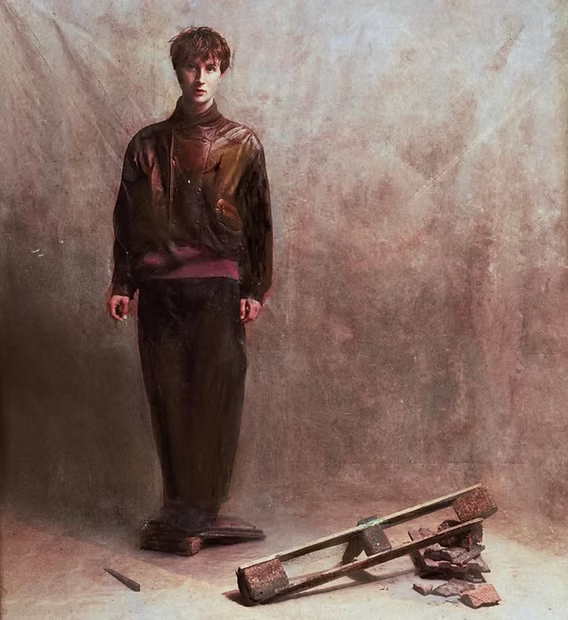
A lot can change in a year, and nobody knows that better than Galway-born singer-songwriter Dove Ellis. At the end of 2024 he was a relative obscurity with no music released; by the close of 2025 he’d become indie’s latest it-boy, fresh from a US tour supporting band-of-the-moment Geese and with a timeless debut album that drew five-star reviews from press and public alike. In the process, he’s emerged as perhaps the most exciting and talked-about new act since Black Country, New Road, yet seems entirely unbothered by such a surge in attention. He’s given hardly any interviews and maintains almost no social media presence – all of which left plenty to unpack when we met over Zoom, where Ellis appeared relaxed and, at last, ready to talk. He opens up about everything from what the press has misunderstood to his cryptic lyrics and why he nearly had to pull out of the Geese tour.
Let’s start with the album and the reaction to it. Both the public and the press have been all over it – did you expect that at all, and how have you found the response?
I wasn’t expecting it. I mean, maybe there was a certain point where I was expecting it once we started doing the Geese tour and all that kind of stuff. But essentially what happened is everything escalated very, very quickly, it’s no more complicated than that. Stuff was way slower even this time last year, and then we got lucky and got on that tour and all that kind of stuff. I think that kind of happened with Geese too, they exploded before they went on that tour so being there in the sightline of all of these fans who were just rabid for them was obviously great. But it was a blessing and a curse, because it meant the album was going to kind of get the tail end of that. I’m unbelievably grateful for it though, I couldn’t have ever imagined this was going to happen. At the same time I think it’s generally good to ignore it because once you put something out in the world, people are trying to pin it down, and as an artist you want to make sure you’re not pinned down.
Has it resulted in any pressure to follow up with another great album, do you feel more pressure because there’s more eyes?
No, not at all. If anything, it’s probably less. I recorded it in September and I put it out in December, and the reason we put it out so quickly is just because I didn’t want to be sitting on it. What’s more pressure for me is when I’ve got a lot of songs I’m finished with and they’re sitting around, that’s what puts pressure on me. I needed to sort of clear the catalogue and get that out. Now that I have nothing I’m waiting to release, nothing ahead of me, I’m starting a fresh slate, as they say. That’s kind of nice.
For the album, you signed with independent label AMF/Black Butter. I imagine you got some attention from major labels, what made you want to go independent?
I didn’t really click with some of the other people that I’d be meeting, I knew that’s just not who I wanted to be speaking to for however long I’d be signed to them. People at AMF treat me good, but also at the end of the day, the difference between signing with an indie and signing with a major are not immensely different to you as an artist on a day to day level. It might be different for the big pop acts who get a lot more input from A&R and all that kind of stuff, but for artists like myself, it’s fairly similar. The thing about independent labels is that they tend to be a bit more short term and that’s the main thing that I was thinking about.
There’s a lot of natural imagery – lyrics about the sea, the sun, fields, and caves, and it’s obviously called Blizzard. What drew you to writing about nature, or was it just subconscious?
It was definitely subconscious, yeah. I suppose at the time of writing most of those songs, I was trying to get away from anybody’s head, like I didn’t want to be describing this or that person’s inner thoughts. I just wanted to put some people in a scenario, so as a result, nature became kind of imperative to that way of writing.
The lyrics throughout are quite cryptic and the narratives have very little context, especially the “failing shotgun marriage” featured in To The Sandals. Is that sense of ambiguity intentional?
I don’t know, I’d like them to be a bit less obscure, really. I didn’t think about it too much though, I was just flying stuff out a bit. I also don’t really write with any story in mind, I care a bit more about sentences than I care about stories, so as a result it can kind of go down that route. Stories can be really tricky if you get too caught up in it and it narrows your focus. Like the shotgun marriage thing, I can’t even remember saying that, I don’t know how that got to the press, fucking horseshit, but I’m glad. Ultimately, with this album and with what I’ve been doing the past year, I was a bit more interested in developing what I’m saying in short sentences as opposed to the story as a whole.
The press regards you as an enigma, you’ve not done many interviews, you’re not very active on social media. You’ve got the lyric “keep the cameras off my face”. Is that distance from the spotlight intentional? Does it come from shyness, or just a desire to stay clear of that side of fame?
The tricky thing about it is that the last thing I want to do is come across as an enigma, it was a shame that that was a headline. When people are trying to market you or digest you on social media, your silence is almost as loud as what you say, so if you’re really silent, people are going to call you mysterious. It’s a shame that comes across as intentional, because the dream for me is that no one really cares. When people do care, there’s not much I can do about it and that’s just kind of how it goes.
One part of it is what I’m comfortable sharing, maybe, but it’s more about who I’m talking to. I have no desire to be running down to the BBC or to any sort of these big publications, I don’t really know what’s in that for me besides people in the music industry saying that’s going to help with exposure or whatever. I would much rather be talking to someone like yourself who kind of us together are trying to make something out of what we’re doing, you know what I mean? We’re in a different scene. But I also don’t want to avoid interviews, I don’t want to come across as some fucking mystery man bullshit like that’s not really my scene. At the end of the day, I just forget about all this stuff. My own lived life is probably unbelievably different to how it might come across, it’s just very normal, and that’s where most of my focus goes. A lot of time I can’t be arsed to try and get the PR right.
Do you think some artists risk becoming too visible now, and that the constant public demand for access can flatten the listener’s imagination? Is there some power, in the age of social media, in remaining a little unknowable?
Yeah I mean, ultimately, social media is just shit. It’s not helping artists and it’s not helping listeners. I understand when artists are expending a lot of energy on social media, it only makes sense because it’s what you’re told to do and it clearly is a big part of why they’re making money and why they have fans. That leads to young artists seeing that and thinking they’ve got to do that too, but having been a young artist myself, trying to do social media would have been the worst thing in the world, and really, really the antithesis of what being creative is. I’m probably talking grandiosely here, but if anyone who was a fan of myself and was trying to be a musician realised that maybe you don’t have to have it as a really social media centred thing, I would love that because you really don’t.
You supported Geese last year, do you remember where you were when you found out and what the immediate feeling was like?
I think I was in bed or something, I can’t really remember. It was good, the whole thing was basically surreal, it didn’t feel like it was going to happen until we were there. We didn’t get our visas cleared for it until like five days before we left. There was a really strong chance we’d have to cancel, we were just waiting on immigration to say we could come. They blocked it once and we had to apply again and it fucked everything, so it was very near the situation where we weren’t going to make the first half of the tour, and if we couldn’t have made the first half, we probably wouldn’t have done any of it because of money. The actual feeling of doing the Geese tour was a lot better than the anticipation and worrying and all that kind of stuff. But the tour itself was brilliant, it was a blast.
What did you learn from the tour? Did playing those big rooms every night night teach you anything, or were there any lessons from the band?
Yeah, definitely. What it taught me about playing in the big rooms is that all you have to do is relax and it’s kind of the same. The noise or like the size and stuff can make you quite anticipated pre-show, more so than if you’re playing in a pub that’s kind of empty. It was more the driving that was the big impact on me. The playing was really cool, it was really nice to know that there was going to be a fanbase there every night, I didn’t have to worry about whether there’s going to be 20 people in the room – that was great.
The hard thing to stomach, or the thing that you fall in love with depending on the person, is waking up early every morning and driving for hours and hours. With this tour in particular, it was really packed in close together. We were away for months, but really we did the tour in two weeks and we drove from Los Angeles to New York in two weeks, so we were just blowing along and we never had time to relax after a show or anything like that. It was just hotel room, get up, go to bed, blah, blah, blah. It was clockwork, it was a bit monotonous even at times. It was kind of like being thrown in at the deep end. It’s definitely shaped my attitude to how I want to tour in the future, and I’m not sure if I want to do it exactly like that. I think the thing I learned from Geese is you need to be tough and hard workers if you want to make this thing work, because they fucking are, they’re just on the grind.
You recently played The Windmill for Independent Venue Week. Do you prefer playing smaller stages like that compared to the bigger venues, and do you approach them any differently?
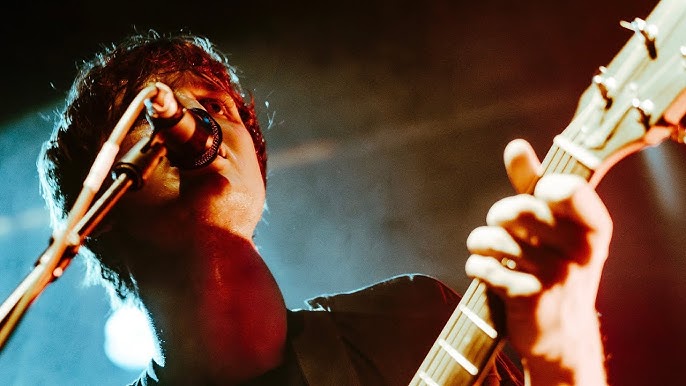
I think I prefer the smaller venues. It’s a lot more immediate, the feeling of what’s happening. Playing at the big venues, there’s such a big degree of separation and you can feel more alone even though there’s way more people. When I play in the smaller venues, I feel a really immediate sense of communication with the people that are in front of me, I feel like I can play off people like that a lot more. But then again, I see a lot of artists that I’ve loved over the years who clearly can kind of get that across in a big room, so I think the big rooms just kind of take a bit more practice. I’m not used to them like that, it just happened really quickly. Since I’ve come back, we played The Windmill, we played ICA, which is a bit bigger, but it’s not the same.
You grew up in Galway, how did that environment shape you both musically and personally? Was there much of a music scene there?
First of all, there’s an aspect to it which is hard to understand because it’s all that I know, really. But yes, there is a very strong music scene in Galway – the two main ones that I’ve always encountered was on the one hand, what it’s most famous for, which is the really rich trad scene, but I was never really a part of that. I went to watch it in certain pubs in town, but I was never part of it because I don’t really play that kind of music, then the other side of it was shoegaze and 80s alternative rock and indie which Ireland has always had a big love for, like The Cure. I quite like that music now, same with trad actually, but I was never hugely into that when I was 14, 15.
For me, music was a thing I did at home on my own, it was very individual – there wasn’t much in a social setting, and once lockdown happened, it only compounded that. Once I moved to the UK, basically, is when I started playing live and doing music in a much more social kind of setting, and that took practice, let me tell you. In terms of how Galway actually affected my writing and how I became an artist is where it gets hard to say, but at the end of the day, when I’m talking about a sense of space or identity, I always find myself thinking of Galway. I think about Galway even more than I think about Ireland.
You mention playing music from an early age in Galway. Was there a moment when you realised that you’re pretty good at this and music is something you could pursue as a career?
It evolved without me being fully aware of it, I suppose. It kind of just happened. I was dead serious about music when I was like 11 or 12, but I never thought about doing it for a career. I thought about it being the only thing I’d do, but it wasn’t until I went to university when I started thinking about how I sell it on what I’m doing – and then I did, and that’s where all the trouble started, you know. But before that, it was just me in a room making a lot of music on my own, for better or worse kind of thing.
After Galway, you moved to Manchester and then to London fairly recently. What made you want to make those moves and what did those cities give you creatively?
I’ll talk about Manchester because I’ve only been living in London since last September. I wanted to move in the first place because I had a stupid idea when I was a kid that I should go to university if I wanted to do music. Most of the ones in Ireland are music degrees at universities, and I thought it would be better if I went to an actual music school, which I did – I went to a place called the RNCM in Manchester. I don’t regret it, but it was definitely naive. But Manchester is what changed me from being someone who made music totally on my own into really understanding music in a social way. That allowed me to understand that there’s not a whole lot more important about it than what you’re doing with people in real life, you know? Over time in Manchester, I started playing in the venues around town with a few more people in my band and stuff. Eventually it got me more into the local scene, and once I had a bit of a regular calendar of gigs, it felt like I was finally part of something, which was great.
You mention the social aspect in Manchester, and a difference between Manchester and London is probably how collaborative the Manchester scene is. You’re close with bands like Westside Cowboy and Holly Head, and there’s the whole No Band Is An Island scene which you’ve been involved in. How important or helpful was that sense of community to you as an upcoming independent musician?
Yeah, it was essential. It was the difference for me personally between a life in music which was up until that point very, very stressful, and a lot of it was kind of a bit aimless, because I was doing it so much on my own, and it’s tricky to see how it matters when you’re just doing it on your own. Before No Band Is An Island, when we were all playing at venues, I wasn’t nearly one of the most prolific people on the scene, it was Cowboys, Martial Arts, Holly Head and a few other bands, they made that scene and I was just lucky to be part of it. But being a part of it is very much what made me think that music is not something that I just want to be watched, but lived, and I hope it actually impacts people who come to watch it, if that makes sense.
That sense of community is seen in the album too, with Paddy and Reuben from Westside Cowboy on bass and guitar and Saya from Mary in the Junkyard on viola, amongst many others. You gig with a band as well, what makes you want to involve all these people rather than keeping it a solo project?
I just couldn’t do without them, you know. I can only play what I can play and I don’t really want to be going around touring solo guitar; I’ve done it a couple of times and it’s fun because the fucking ease of it is unbelievable, but eventually you go mad when you’re on your own. For it to be anything worthwhile doing, I have to be around all the other people.
At the same time as all the collaboration, I read that you self-recorded and self-produced the album. Is that right?
I self-produced it, but I didn’t self-record it. We did it all at a couple of different recording studios. One was in Liverpool called Nan’s House and the other two were in London. I worked mainly with two recording engineers who were very important to the record, Sophie Ellis and Danny Bennett Sprague. I produced it myself because I just didn’t bother to get a producer to help me, but I’m glad I didn’t because it was a big learning curve doing it all myself, which was good. I don’t really have a desire to get someone to help me in the control room, I just wanted to be with either Sophie or Danny who was engineering.
You’ve said that your longest musical influence is Prince, but I was wondering if you have any non-musical influences, like films, books, or artists that influence your work?
All of my earliest formative influences are just music, but I think since my late teenage years, the only way I’ve gotten better at writing is through being much more occupied with reading, basically. The main influence is still music, though, and the biggest lyrical impact an artist had on me in recent years is Gillian Welch – I just love the way that she writes lyrics, I played a cover of her at that Windmill gig. She’s one of my favourite artists, I love her. Outside of that, I’ve always been into poetry. I’ve always liked Samuel Beckett, and I kind of had a phase with the Beats, like a lot of us musicians do, when I was nineteen with Jack Kerouac and Burrows and all of them, they were pretty important but I’m not really into them anymore.
In terms of films, I’ve never been a huge film head, I generally just watch them at the cinema. I don’t have a monitor or a TV, I’ve just got my laptop so I never really end up doing it, I always just end up reading or listening to music, you know.
It’s nearly three years since you released your first single Adonis, what do you think you’ve learned in those years – how have you developed, musically or personally?
I don’t know, I can’t even remember releasing that song because stuff has changed very quickly. What’s really changed is my attitude to music, I see music in a much more long-term way now compared to when I released that song, I was in way more of a rush and it felt like I was shouting into the void. These days, I know that all I’m going to be doing is music no matter what happens so it feels like a lot more settled down. And back then, being a musician didn’t really feel like it was a part of the relationships in my life, I kind of kept my social life away from music, and music was this thing where I’d go to be on my own. That’s gone for me now and that’s the best and also the most scary change, it really feels like I can be an artist a lot more out in the open now and consequently I worry a little bit less about perception and social media and that side of things.
Adonis was three years ago, where do you see Dove Ellis three years in the future, what would you like to have achieved?
I just want to expand upon it. I think right now it’s at a nice tight little starting point or whatever and I want to work out in every direction if that makes sense. I’m really not someone who’s following some kind of path, I don’t really think that it’s a road or anything, it’s more just unfolding out as much as I can. I’m not trying to narrow or pin down anything so it’s hard for me to say because I don’t really have any goals or anything like that, I just want to make sure I don’t block myself up.
Words: Donovan Livesey