
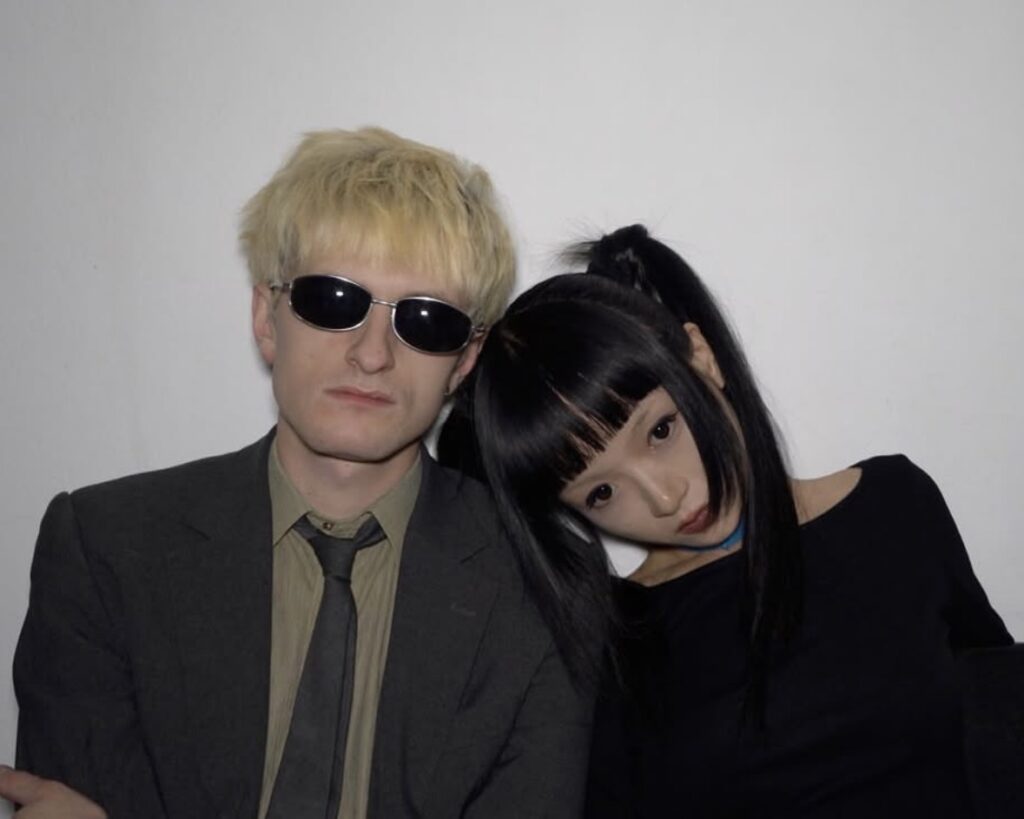
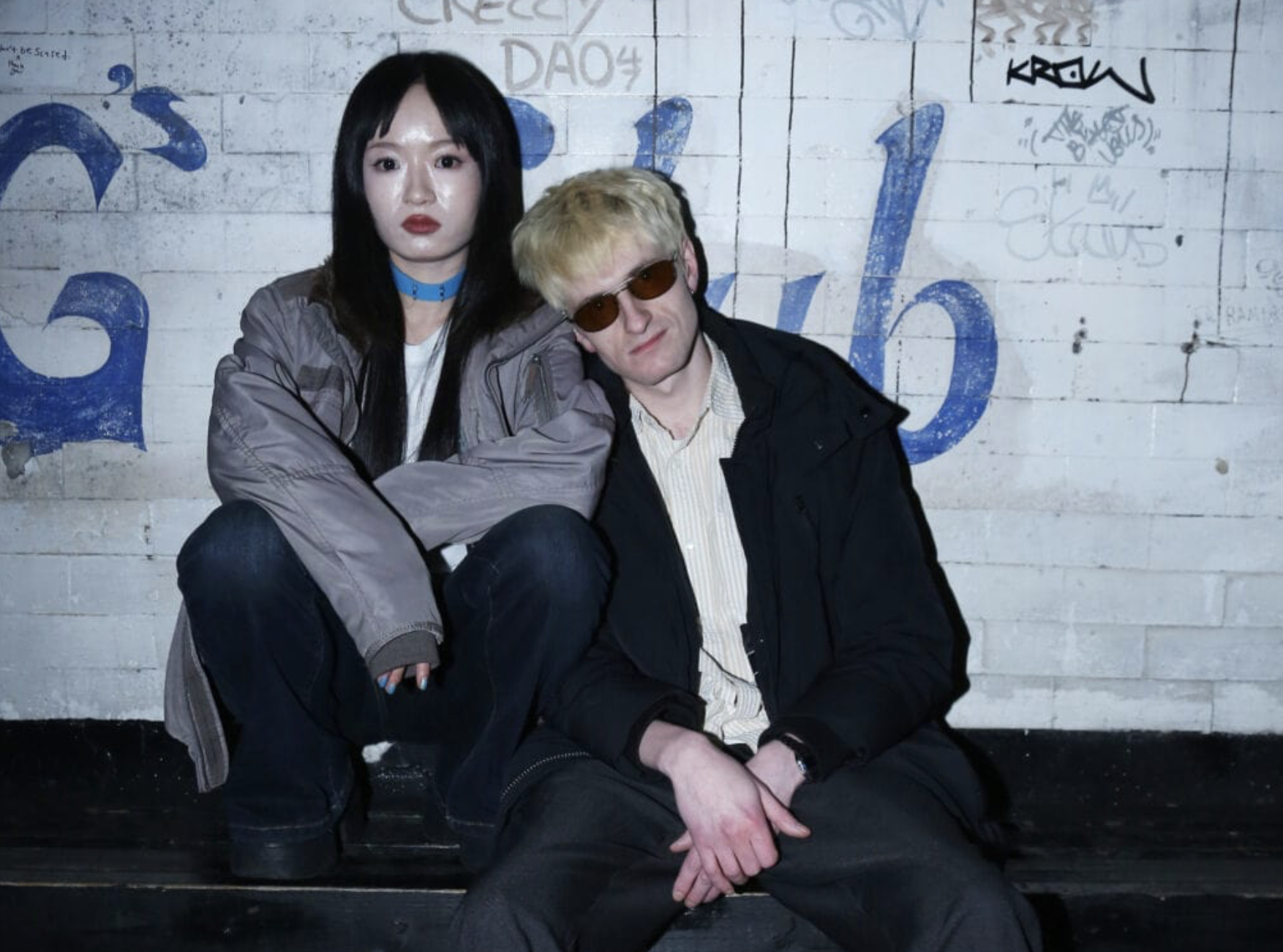
Manchester two-piece SILVERWINGKILLER fuse glitchy electronics with aggressive bass, live breakbeats and yelled Mandarin vocals. Their maximalist sound draws inspiration from ultraviolent video games you’ve never heard of, conjuring a kind of dystopian, rave-fuelled psychosis that has earned them support slots with Fat Dog and a reputation as one of Manchester’s most incendiary live outfits. Before their gig supporting Adult DVD, we sat down with James and Yushang to talk about everything from the drug-like rush of gigging to influences from Shanghai and how their “dodgy pasts” feed into the music.
You’re supporting Adult DVD tonight, what do you hope people feel when they leave a Silverwingkiller show?
James: That Northern punk is back and it’s electronic – same goes with Adult DVD. And just something refreshing. I don’t care if they like it or not, but the thing with Silverwingkiller is there’s a lot of different elements to it that they’re bound to like some of it.
You both live in Manchester now. You’re part of a growing scene there with loads of unique bands. What’s it like being part of that?
James: It’s exciting. A lot of the city has obviously been touched by Oasis, but people forget that The Hacienda was here too, and all the electronic stuff with Joy Division, New Order, A Guy Called Gerald, the whole acid house scene. We use a lot of 303s and that, so it feels great to be part of it. And it’s been a long time where everything was about the London scene – London band, London band, south, south, south. The North kind of gets ridiculed because of that Oasis stereotype.
But I feel like we’re showing the rest of the country we mean business. Even outside music there’s loads of development going on in the North right now. London’s so expensive and gentrified, it’s hard to get that real grittiness there anymore. There are a lot of electronic bands in London at the moment, but some of them sound like Y2K pop music. It hasn’t got that grit or gore that we’re trying to bring back, that punk energy.
Manchester’s not quite as gentrified yet, so there’s still a bit of rawness to it. We’ll try to keep that going while it lasts – before house prices go up again and there are a million skyscrapers everywhere. The skyline’s already changed loads. It’s mental.
You started playing together for the first time for James’ birthday party. Was there a specific moment after that when you realised Silverwingkiller would continue and be a real project?
James: It’s kind of addictive playing gigs, you play one gig and you get that adrenaline boost which hits harder than any drug, so you’re like fuck it let’s do another one. You keep doing more and you become an addict and end up playing everywhere. We didn’t see it as a serious thing when we started, we were just doing it for fun and were prepared for everyone to kind of hate it, so for people to appreciate it is really touching. We just keep riding the wave and see what happens.
How different is the band now compared to early rehearsal days in the industrial units in Manchester? How have you developed musically and personally?
James: I’d say it’s a lot tighter now. It used to be kind of trashy all the time because I don’t use a kick track on my drums – I just play and hope for the best. I’m not really a drummer, I used to play guitar in bands before. But when it came to making electronic music, I didn’t want it to just be a production thing – I wanted it to feel like a band. Having that live drum element makes it feel like a fucking punk band, rather than just a produced single from the kind of two-piece you get a lot these days. So yeah, I think it’s definitely got better with the drums.
Shang: I would say band-wise, we care more about the idea of the band, not just how it sounds. Now we want to be ourselves more, we don’t want to change the core idea of Silverwingkiller, just develop more different sounds. At the beginning we don’t really care about the concept, but now we know we need to be Silverwingkiller. We don’t want to be bullshit, we don’t want to be too pretentious as a band.
James: Be nice to everyone, always give them a time of day. If anyone thinks we’ve got a good set, we always try and get to know them a little bit as well. Try and give it an inclusive level.
You’ve both been in bands before, Yushang played bass in a folk rock band in China and James has been in a few post-punk bands in south London. How did you land on such a different genre and vibe for Silverwingkiller?
James: I’ve always been into guitar bands and I’ve never had an electronic project – growing up, the idea of electronic music is quite difficult, but once you get it it’s almost as easy making guitar music. I think there’s a lot of demand for electronic bands at the moment, there’s the club scene and DJ nights and everything, but it’s missing the live music element and the kind of band element.
You could say we’ve gone from guitar bands to electronic bands, but to me it’s meeting both worlds, you know. Trying to get people out of the clubs, into the venues, out of the venues, into the clubs, and just meet halfway amongst friends. I would love to bring guitar in the future as well.
You mentioned how there’s been a boom in electronic bands recently, what do you think is causing that?
James: I think you’ve got all these club scenes and the DJ world going on, and the band world is kind of standing there with its dick in its hands like, what’s going on? You know what I mean? But now it feels like things are meeting in the middle a bit. It’s like, you want to be in live music, you want to be in a punk band, but you still like the electronic scene and the clubs and everything. So you just kind of melt them together. I feel like with indie bands, the best kind of music is when you’re at least trying to do something new.
You’ve got loads of bands that sound like Arctic Monkeys – but Arctic Monkeys were the first, so it’s kind of done now. You could be the best band that sounds a bit like Arctic Monkeys, but it’s never going to be the same, you need to have something that feels more refreshing and different. I’m not saying we’re making something completely new, because obviously we’re influenced by loads of different things, but I think we do push boundaries a bit in the sense that there are different sounds and different feelings in what we do.
What do you think electronic music allows you to achieve that guitar music doesn’t?
James: I feel like when you’re in a guitar band, you genre-vise yourself too much, you’re always trying to follow certain rules and formulas but if you go into an electronic band, you can play stuff that sounds techno-ish or a bit drum and bass-ish and stuff, and I feel like you’re more likely to sound different. We always talk about other electronic acts in Manchester, we’re all part of the same scene but we all sound a bit different, where in some guitar scenes the bands sound quite similar. Electronic is just the memo, and you can follow it however you want, it’s the beauty of it, no one sounds alike.
You played gigs with visuals in the background before, you’ve got some cool music videos and the cover art for your music is really good as well. How important is the visual side to what you do?
James: We had a reel we used to play, like a 20-minute loop, that had Gaddafi in it, and a lot of ‘Ishida Killer’, a really violent Japanese film. Love him or hate him, Gaddafi is a very interesting dictator. He’s not a good guy, but he’s wild, you know what I mean? He’s like a made-up villain, like in The Dictator, he’s basically him. He’s got his golden AK-47s, he’s got his Nuns of the Revolution female guards – he’s a crazy guy. I don’t support him.
We’re not really video makers or anything, but a lot of the time we’ll have a song coming out in a week and we’ll just grab a camera somewhere in Manchester or at our house, use some editing software and just see what we can do with it. It’s all about visuals, like a video game. Sometimes we’ll practice while watching ‘Metal Gear Solid’ playthroughs, because when you get the music right it’s like the visuals of a video game.
A lot of the time I say it’s not necessarily influenced by bands as much as it is by the feeling of certain video games. There’s a Japanese video game designer, from ‘Street 51’, who’s a bit like the Takeshi Miike of video games. We never directly copy any music from the games, but the feeling of it – I feel like Silverwingkiller could soundtrack one of his games.
You’ve spoken before about your aesthetic feeling kind of illegal, “music you’d find on the dark web”. What draws you to that vibe, and are there any artists who’ve done it before that inspire you?
James: We grew up with quite dodgy pasts, and that whole feeling is the best way to get that punk energy. Having this kind of illegal feel makes the music feel a bit dodgy, a bit threatening, and it gives it this otherworldly atmosphere.
I can’t really think of many other bands that do it the same way. Maybe not as heavy, but Brain Bombs are a bit like that. But we’re not as progressive as them, that’s kind of too much. I don’t want to say Death Grips, but I’ve said it now, so yeah.
You’ve got a second EP coming out in the summer, how does it differ from the first?
James: There are more world music samples in it, and there’s more space for it to breathe. It’s still heavy, but some of it’s maybe a bit more on the clubbier side. I think I said before, if the first EP’s a Chinese gangster, the second one’s a Somali pirate. It’s still got that illegal feel, but it’s more desert-influenced, let’s say. We had a lot of ideas while we were in Morocco, and that kind of feeling comes through – while still keeping respect for the culture, obviously. So yeah, it still has that illegal feel, but it’s maybe a bit more world-influenced.
Yushang, you grew up in Shanghai, how did that shape your creative instincts? Was there much of a music scene there, what was it like?
Yushang: When I was growing up it was more of a band scene, so I joined a couple of bands and played bass. But nowadays it’s more of a club scene. Young kids don’t really care about bands – they just want to go clubbing, get drunk and listen to techno, like Berlin-style DJs. There’s a lot going on in Shanghai though, it’s a really interesting place. For me, it’s more just where I come from – sometimes the lyrics are just about what I want to say, or things that happened in my experience. I don’t really think about it too much.
You’ve got lyrics in Mandarin and Shanghainese, how does that feel different from writing in English? Do you prefer it?
Yushang: Of course, yeah. It feels more natural. When it’s in English it’s quite basic sometimes, but in Chinese there’s a lot more depth to what I’m saying. A lot of the time I’m just trying to get the English right as well.
Silverwingkiller formed two years ago in 2024. Where do you see the band in another two years? What would you like to have achieved?
James: We’re doing this EP and then maybe another one. We’d like to do an album too and see where it goes from there. We’ve played China before and we’d love to play Asia again. We’ve talked about going to America at some point – the fees are expensive but it’s been discussed, and we’ll work it out eventually. Mainly we just want to play as much as we can: be everywhere, do everything. Get the new stuff out rather than keep playing the same material.
Maybe expand the band as well. If you keep doing the same thing all the time, you get bored and we’ll get bored so it’s about evolving and pushing it forward. Maybe in two years we’ll be a 20-piece band, who knows. We’ll clone ourselves, ten YuShangs, ten Jameses. A whole choir of YuShangs all singing in Mandarin – it’ll be insane.
Shang: Massive.
Words: Donovan Livesey