
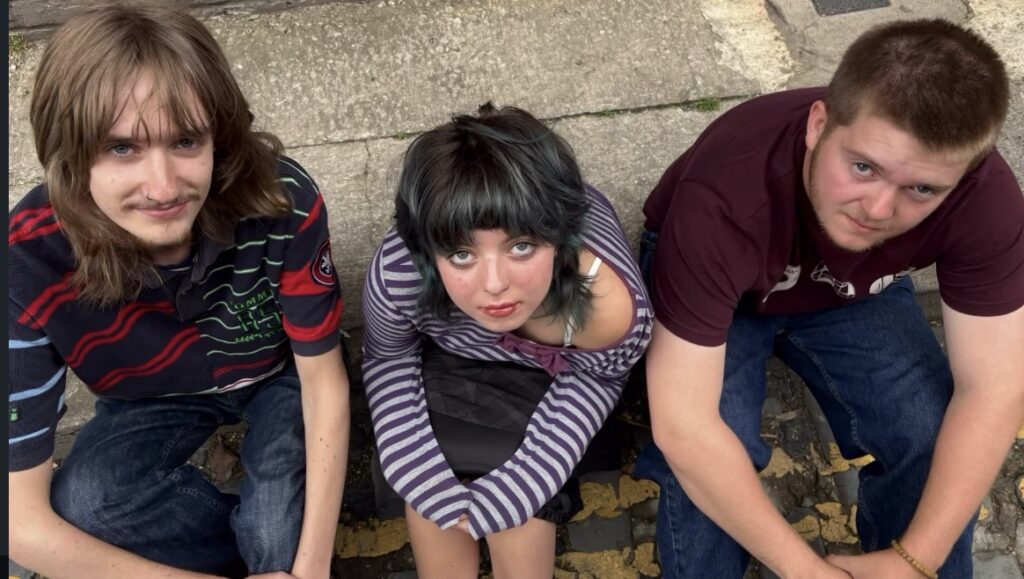
Nap Hotel are firmly amongst the best bands in Sheffield’s sorely underreported grassroots scene, a dream-rock trio already outgrowing their ‘uni band’ status. Ahead of the release of their sleepy, noisy debut EP, we sat down with Alfie (vocals/guitar), Joey (bass) and Will (drums) to discuss surrealism, trauma bonding, and why they’d probably be worse if they were based in London.
How did Nap Hotel come about?
Will: We all take the music course at Uni of Sheffield, and day one in first year both me and Alfie were late and we rocked up to the building and we were like, is this the music department? We go in and there was literally two seats left at the front and they were both next to Joey, then we sat there awkwardly and Alfie spent the whole lecture trying to quietly open a Coke can that got shook up.
Alfie: But we all made eye contact when it happened and then we became besties.
W: Like trauma bonding. Then we did a year of playing jazz together and doing recitals for the course, then we got sick of that and thought we should just actually write some tunes, which we did.
Where does the name come from?
Joey: I had a dream a long time ago. If you’re having a very busy day, you’re in a city and you don’t have time to go home and sleep, there should be a place where you can book like a pod to sleep in for a few hours. A nap hotel. I think they might actually exist in Japan but I hope they don’t because if the band falls through that’s the backup plan.
Alfie: I think the name has actually really informed a lot of how we play and what I write about. We love a sweet, surreal theme. No plans on changing.
Who are some of your main musical influences?
W: We’ve been thinking about this a lot recently, trying to narrow it down for press stuff. For me, it’s a lot of 90s slacker rock and noise rock and Wilco and Sonic Youth. Because we started out playing jazz, that’s always in the back of my mind as well.
A: I got really into Wednesday, she informs a lot of what I do. But I think actual songwriting goes back more to Neil Young, and the Velvet Underground was huge for me. At the beginning, it was a lot of Pixies, we used to do Pixies covers.
J: I think that’s what makes us work well, we don’t all grab from the same influence. I’m into a lot of funk stuff and I think it shows through my playing, I like stuff like Andy Rourke and Norman Watt-Roy.
Do you have any non-musical influences, like films or literature that inspire you?
A: Thinking back on the whole surrealism thing, I watch quite a lot of David Lynch films and the EP cover was quite inspired by that. I remember we were in my bedroom, I had my mum’s projector and I was just finding pictures on my camera and projecting them because I wanted it to feel a bit weird and surreal.
W: The visual aesthetic is quite important, we’re always agonising over what outfits we’re going to wear. We’re like, what’s everyone wearing? That’s harder than actually writing tunes. And just more broadly thinking about our art rather than just being musicians.
You describe yourselves as making ‘sleepy, noisy’ music. How do you maintain that balance, and do you have to be careful not to go too far into one or the other?
A: We’ve had that description from the very start and I think the more we play and write, the more we come into it, which is interesting. In terms of my voice, I’m always very aware of whether I’m whispering or singing nice or going for a scream, so I think that contrast is quite voice-related. I had a phase where all of the gigs, I would literally just scream it all. My dad came to one and he was like, oh you screamed a lot of that. It’s always about balance, loud only feels good because there’s quiet.
W: It’s definitely become more of a thing as we’ve gone on, and it’s almost like a challenge because if you can be quiet or a bit tame and people still dance, that’s more impressive than going absolutely ham.
You’re based in Sheffield, how do you find the Sheffield music scene and community?
W: People talk about ‘the world’s biggest village’, and that’s been very helpful for us because we can just go to a gig and immediately meet other bands – everyone’s supporting each other, you’ll talk to somebody and then they’ll book you or you’ll book them.
J: You’ll know at least one person wherever you go, it’s such a big city but everyone’s really close.
W: We’re definitely aware of getting trapped in one place, you can get quite comfortable playing the same venues. We’ve managed to branch out a little bit so far, but you kind of have to fight to get the variation.
How do you think Nap Hotel would be different if you were based somewhere like London?
W: The culture is definitely different here with it being a smaller city, and especially being a uni city. Somebody was talking about London and about how people will go to gigs just for the art and because they want to see music, not because they want a night out or to see their friends. Obviously that would be nice, but it’s just another challenge. It means you have to get your point across even clearer because not many people are just going to take a chance on some random gig. So if we’d been in London, we might have actually been worse.
Your debut EP is on the way, how are you feeling to finally have it out?
W: So good. It’s been a long time coming.
A: I’m very precious about the recordings, there were a few errors and a few things I didn’t play quite as well, but we did it all in three days with Evan J Martin and it kind of captures where we’re at and what we’ve been doing.
J: It’s like a time capsule, something to look back on because it came at the end of our first year as a band.
W: Even tonight, I feel like I play completely differently but it’s good to have that benchmark because now we can really measure ourselves and we have a standard. Now we can keep getting better.
A: And it makes everything feel more real and more concrete, it feels so weird having something tangible. I listen to it and I can’t believe my voice is on this, it’s a bit freaky.
It’s produced by Evan J. Martin, what was he like to work with and how did he impact the EP?
J: He’s such a joy, he’s awesome.
A: The best thing about Evan was that he was so involved, not just in terms of the recording but he was like, I’m not sure about this melody, or you could do a drum thing here. He wants to get the best out of the song, not just do his job as a producer.
W: We went into it wanting to have a producer that felt like another member of the band. If we had loads of budget and we could hire loads of people to mix and master and all that, it would be great but having one person being so invested in it made it feel so much more personal.
A: I can’t wait to hang out with him again – it was such a fun three days, they flew by. It didn’t feel like work, and that’s always been a thing we’ve been looking forward to. We came out of the studio being like, yeah I could do that as a job.
Do you think you’ll take any lessons from the process of this EP into the next?
J: Maybe give ourselves a few more days, because it was quite tight for time and it got a bit crunchy near the end. There wasn’t much breathing room to properly think about things.
W: It was a bit frantic going in, because I came straight from holiday and I don’t think we actually got to rehearse, so we went in a bit blind. Maybe we do like a week of rehearsals next time.
Did the time pressure have any positive impact on the record?
A: Definitely. There’s some really awesome moments like the guitar solo in Orbiting was done just there and then. We were thinking we’d overdub it but we tried it and I’ve never played the guitar solo like that. I can’t do it again. And similarly in Ride It Out, there’s this feedback drone thing at the end that I got first take, and it was the last thing on the third day. It’s like an angel came down and pulled those notes out.
What do you hope you achieve with the EP, where do you want it to take you?
W: Definitely further afield in the UK. We want it to be something we can use to present ourselves and get the message across as easy as possible. It’s definitely something we can use as a tool as well as for self-expression, hopefully it will open more doors. And it’s like a diary – I want to be able to listen to it in a couple of years and be like, that sounds like me when I was twenty.
A: Yeah, hopefully we’ll move and progress so to have something we can, not compare to, but just appreciate, I think is really good.
Words – Donovan Livesey