


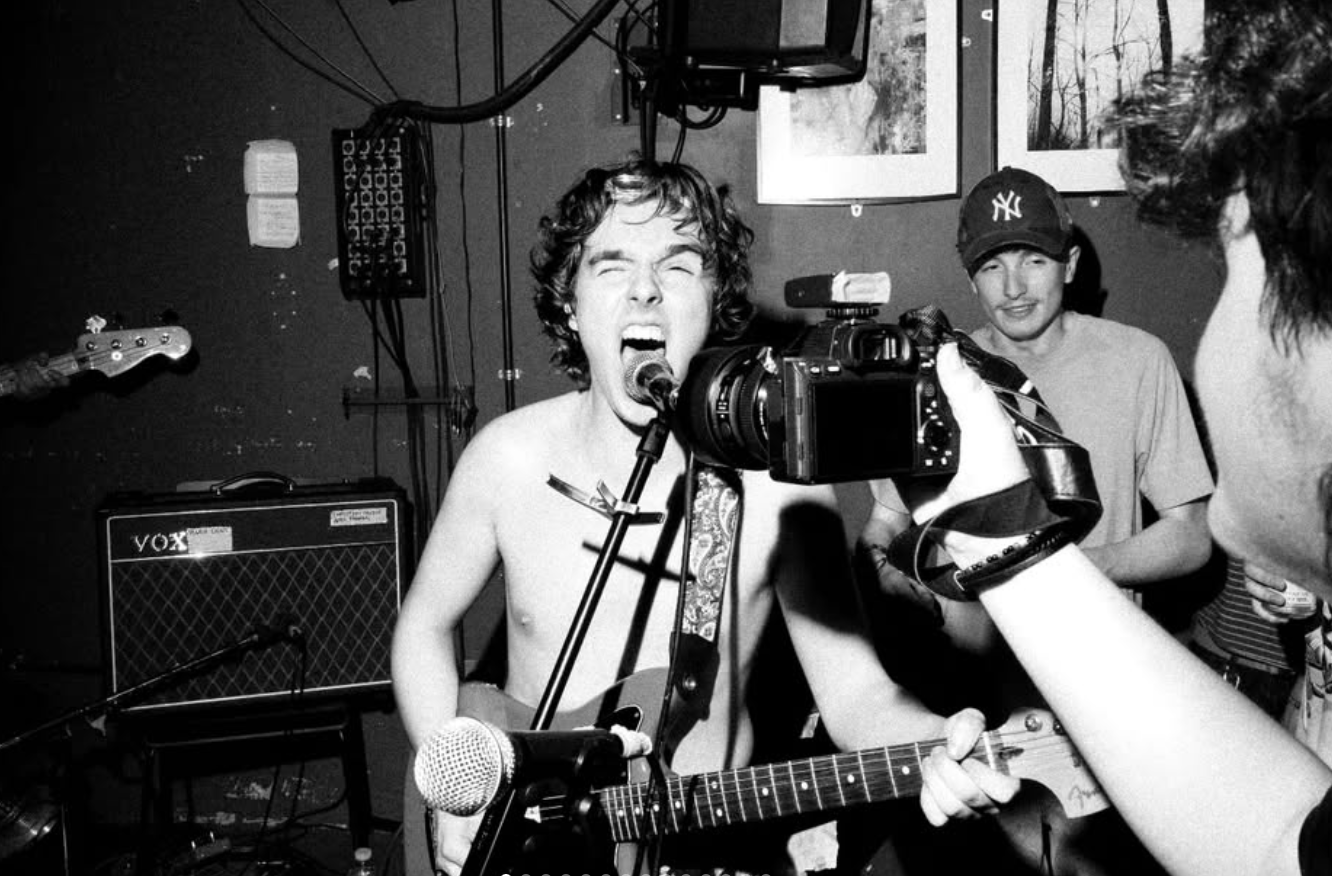
Stoke. It’s not a place often associated with musical exports – a quick search suggests its biggest claims to fame are Robbie Williams and the Spitfire plane. But another name may one day join that list: Christian Music, the Crewe five-piece whose heavy, punk-leaning chaos has carved out a crazed sound entirely their own. We sat down with founder, lead singer and guitarist Josh to talk about everything from his last-minute panic about their new single to the liberating humiliation of being rejected by every label – and why, as he puts it, bands should “have a little whimsy in their life.”
When and how did Christian Music come about?
First day of uni. Staffordshire University, first year. I went to uni to start a band, and then, first day, I started a band. We’ve had 15 different members since then though – none of the originals are there, just me.
Did you have a moment of recognition with the current members when you knew this was the version of the band that would last?
No, they’re still on thin ice.
You live in Stoke, how does being from that music shape Christian Music and the sound?
Well, there’s nothing musical in Crewe where I live, and there’s only one actual venue in Stoke, which is The Underground where I work. It’s such a small circle, so most bands in the local area just don’t have anyone to appeal to. There’s no one locally who enjoys that kind of thing, which is really kind of sad. It’s a miracle that people are even vaguely interested in us.
We did a headline the other day, and we had maybe 80 people in, and then we travelled five hours away to Brixton, and there were 120 people there. It’s so weird how geographically that matters so much. I just don’t think people have a taste for us at home.
Do you feel you’re part of a particular scene in Stoke or Brixton, or do you try to shut out outside influences when you’re writing?
I’m a big fan of live music, going and trying to find new bands and stuff, but in terms of making the music, nothing else in the world matters to me. I don’t listen to anything. The way I see it is, there’s a tiny little gap in music that doesn’t currently exist – that’s Christian Music. That’s the block I need to fill. That’s my job, and the only person who I need to appeal to is me. Not even the rest of the band, fuck them. I don’t care what the drummer thinks! I think more bands should try to appeal to themselves.
How do you think Christian music would be different if you grew up in London?
We’d probably just play more gigs because there’s more opportunities to do so. For us doing a gig, it’s like a five-hour trip to London, and we can’t take that lightly. We need to sort out all the fee, have we practised enough, is there enough space in the fucking car, who’s driving. After all that’s sorted, it’s like, okay, we’re three hours late for soundcheck, and the soundguy is being arsey because he doesn’t like what we’re doing with having two bass players, and then we sound shit and no-one can hear anything on stage after we travel all the that time. Whereas if we were from London, we could just hop on the tube with a guitar each.
Your new track Email is out now. How does it feel to have it released and how have you been finding the reaction to it so far?
The release was terrible, I had a terrible time. Really bad. Everything’s DIY, and a few days before it came out, I had a crazy panic, I thought this thing sounded fucking horrendous – I’m going to have to get it remixed, remastered. Four in the morning, try mixing the snare. Then I fell asleep at some point, woke up the next day, listened to the original version and went, ‘nah, that’s fine’. It wasn’t even that bad.
The thing is, if you listen to our discography, you can hear me learning as I go. And I think that’s something a lot of bands don’t have, or are afraid of – especially with streaming services, where you can take down old tracks. But I’m not afraid of that, I like seeing that curve: on this one, I learned how to mix a vocal properly; on that one, I learned how to mix drums. With Email, the focus was the drums. The song itself, I’m not going to big it up, but we like it, and what mattered most was getting across the energy, which I think we managed.
You talked about the DIY element. Do you enjoy being independent in that way, or would you ideally like to be signed to a label, with people handling things like mixing for you?
I don’t know if we’d even want to be on a label, but it’s well hard. We’re on a publishing company who have gone to all these record labels and said, ‘Hey, here’s Christian Music.’ And all of them said, ‘No thanks.’ At first, that was really shit. We thought, ‘Oh, we fucked it. What are we going to do?’ And then a few days later, we were kind of like, ‘Whoa, no one wants us. That’s actually really cool.’ To be sort of acknowledged as the underground because no one wants us – it’ll make a great book when we’re done.
I hate the idea of going into a studio and having someone else make these decisions. You pay someone 300 quid for a song, they’ll mix it and record you, but they might not understand where you’re coming from. Whereas if you’re doing it yourself, you know it so well that – even if you only know a little about recording- you instinctively know what you want to do with it. I’ve never let anyone else touch this stuff, I can’t.
The music video for Email has a cool montage of cut-out images. All your videos have been quite artistic – what inspires them, and how important is the visual side of what you do?
All the videos we’ve done have only happened because I happen to have friends who are videographers or filmmakers and wanted to get involved. The friends I worked with on the recent video both listened to the song and came back with ideas. Jack had this great concept – so we basically got all these random books: Jack had an instructional photography book, and I had a Chinese Home Cooking book I bought for 20p at a charity shop. Then we were just cutting out, cutting out, cutting out, and collecting all these little pictures.
I remember turning to him and asking, ‘How many do we actually need?’ He said, ‘How long is the song?’ I said, ‘Three and a half minutes.’ And he said, ‘We need 660 frames.’ That’s why a lot of the footage is me actually playing guitar. Then I realised we were still a few frames short, and the only thing we had handy were the ends of a pouch of baccy. So we just rolled with it – and those last 60 frames ended up looking really sick.
Poor Jack had to sit in the office at The Underground for days, scanning folders and folders of pictures. But it looks pretty good in the end.
There’s this idea that music should exist as music, separate from everything else – the Fugazi thing, where you shouldn’t sell T-shirts or make videos. I love Fugazi and totally get it, but film itself is art, just like music. Why can’t they sit side by side in a project? Especially when you’re working with someone who has a really creative idea.
Is Email going to be part of a bigger release?
Yeah there’s going to be an album at some point, which is part of the publishing deal. But I can’t say if that track will be on the album because ideally we’ll have, I’ve done like 15, 20 tracks and then cut out the fat. But there will be an EP at some point soon, hopefully. It’s going to be four tracks, and Email will appear on there. The current working title is Christian Music’s Number One Album EP.
How does the new EP differ from the first two? Any new themes or sounds?
Same old Christo. I don’t know, whatever happens, happens. Especially learning from that last bit of mixing Email, I was in a real panic about it and if you care about it too much, you’ll kill it. So you’ve got to make these instinctual decisions and that’s how you get the best output.
But here at Christian Music, we only make it for ourselves – and the extension of that is I only do it for me. And so whatever this EP sounds like, when you listen to it you’ll know that’s exactly what Josh wanted it to be. I can’t tell you how it’ll sound, but whatever it is, I will be happy with it when it happens.
Parts of European Tribunal were recorded in a garage. Was it the same for Email?
I got kicked out of the garage. It was my parents’ garage, they let me record the EP in there but I was doing all the screaming and stuff. For the first few weeks, they were like, he’s doing his thing, and then four months in they told me to get out. My dad made the garage into his mancave thing, he put some weights in there and stuff. What a waste of space. The garage, not my dad.
We moved into a new space which we recorded a few more songs in, and we’re on the way out again soon with a new spot which will be where the album comes together. All of European Tribunal was recorded in the garage, except the drums which were recorded in a different place that Formal Sppeedwear sorted. So many random fucking places, it’s always really complicated when you haven’t got a full band.
Do you think recording in random places adds to the chaos of it all?
Oh yeah, absolutely. Especially when you’re in these places and you’ve only got a limited amount of time. Like recording with Formal Sppeedwear, at their bass player Beck’s house. I was like, ‘Yeah, I want to record a vocal chorus for this song,’ and it’s midnight and he lives in conjoined houses. We had to be like, ‘You’ve got one take at this. We can’t overrun it.’”
So it’s less chaos and more urgency – the sense that we have to get this take now or we can’t do it. And because I’d already decided on a release date – which I’ve now learned not to do – that probably added to the it too.
But I think more than anything, when you have to make those snap decisions about the sound, you end up getting something rawer. The way I see it, the first time you do anything – say you’re mixing drums – you’ll make them way more aggressive. Then when you go back over it on the second mix, you think, ‘That’s too much,’ and you pull it back. But because we had to work so quickly on European Tribunal, everything ended up doubly aggressive. And I kind of like that.
You’ve done a lot of vinyl releases for an independent band and released some Christo t-shirts recently too. How important is the physical side of things to you?
If it was up to me, we wouldn’t be online. Well actually it is up to me and we are online, because if we only did vinyl, we wouldn’t be able to do what we do in terms of gigs. Unfortunately you can’t reach people otherwise, and a lot of venues won’t book you unless they’ve heard you in some way.
But I mostly listen to physicals. My car’s from 2003, and until a few months ago, when the CD player finally broke, that was the only way I could listen to music. So I had a shoebox full of CDs in there. If I wanted something new in the car, I had to go find the CD—otherwise it wasn’t happening. And when I’m at home, I listen to vinyl. The only time I’d stream anything was if I needed to quickly pull up a reference or if I was walking somewhere.
So the physical thing is massive for me. I think more people should strive for it, and bands should aim to have their output be physical. Ideally, one day, I’d love to take everything off Spotify and maybe stick to Bandcamp. But I really think bands should be physical. That’s what it should be about: playing shows and making records. Actual records. CDs. Not just MP3s on a stream.
In a couple of weeks, debut single Van Rental Service will be three years old. How do you think Christian Music has evolved since?
Jesus fucking christ. Well we’ve been through five drummers and five bassists, but the philosophy of Christo is still the same: if it’s not fun we’re not doing it, and the songs have to make us laugh. If you take it too seriously you’re a fucking lost cause. I hate the serious shit, I’m big on half man half biscuit and Ween – there’s a lot of humour in these bands and it’s way better than some sad shit. Have a little whimsy in your life.
Where do you see Christian Music three years in the future, what would you like to have achieved?
Yikes. I don’t know man, I don’t plan very far ahead. I don’t really have goals, but ideally in three years we’ll be doing very, very regular gigs. We love playing live, that’s basically all we want to do.
Words: Donovan Livesey