

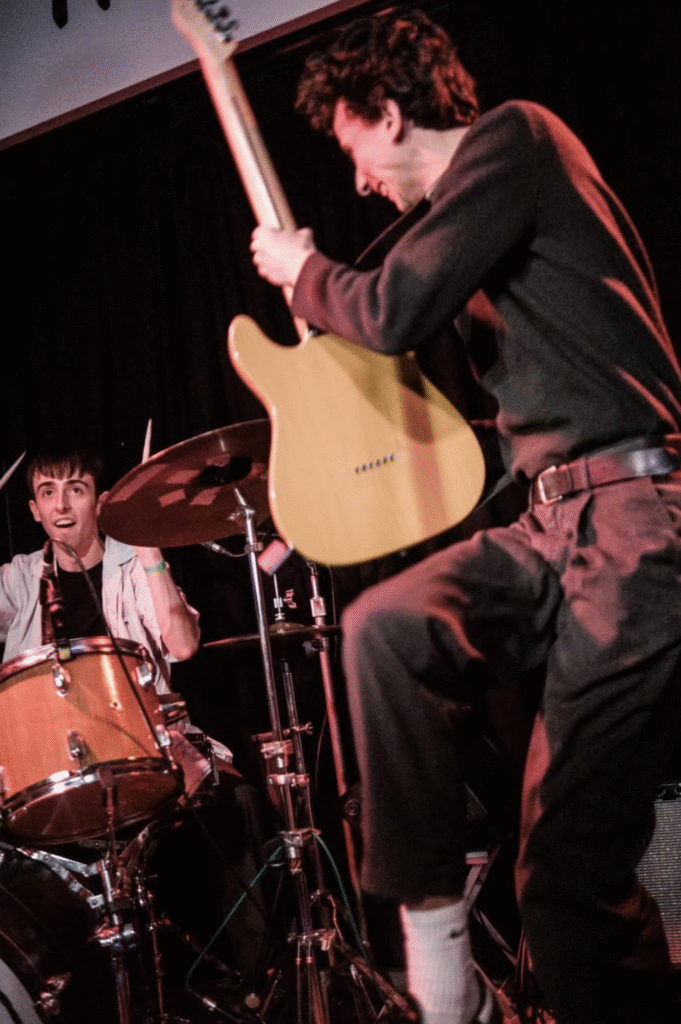
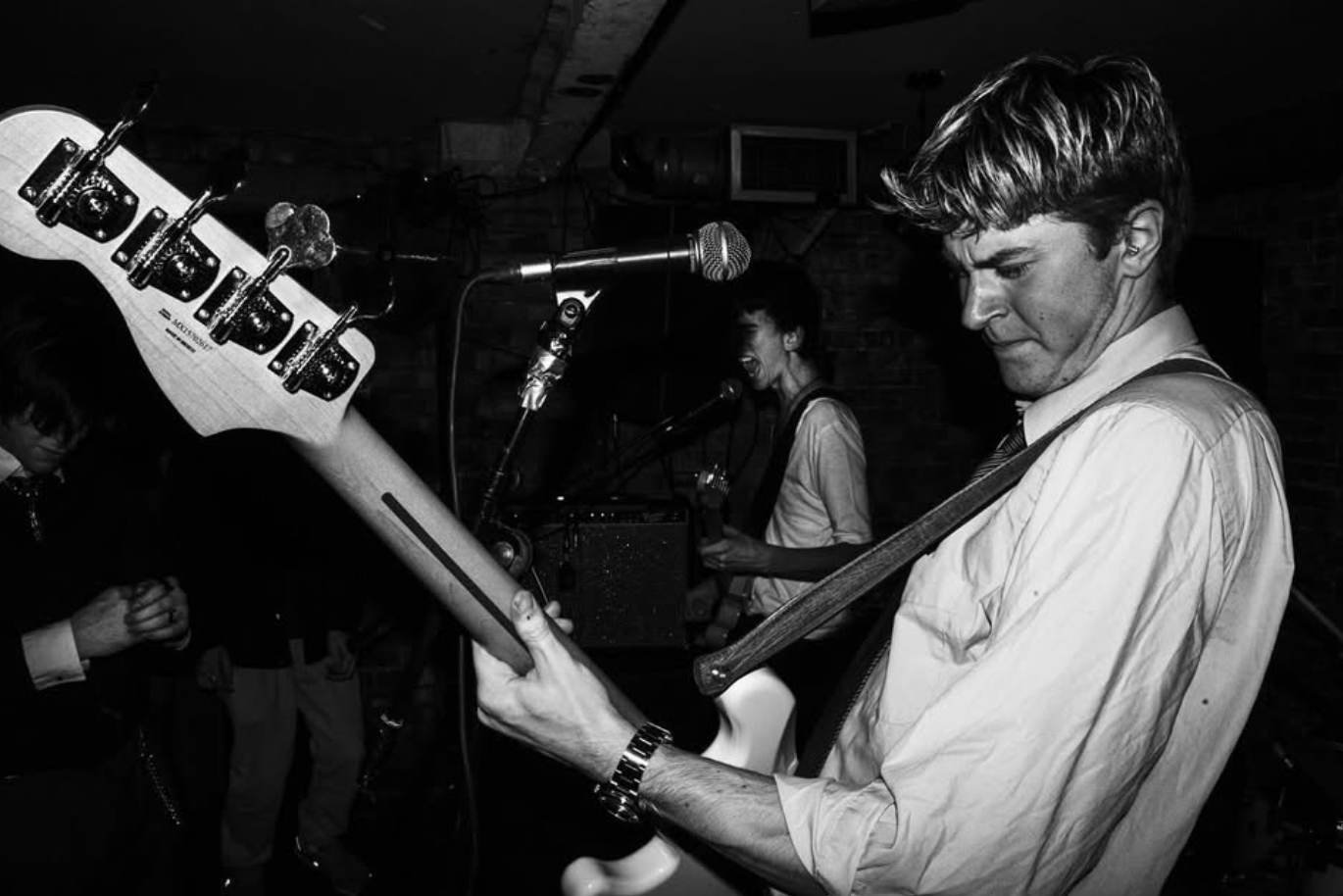
Lisbon-to-London isn’t the usual trajectory for an emerging band, but Common Ideal – led by Portuguese vocalist Sal, who came to the capital intent on making something loud and serrated – are already establishing a distinct presence. Operating entirely independently with bassist Joe and drummer Aaron, they’re booking headline dates across the UK and Europe, even after removing their debut EP from streaming platforms and wiping their social media to make room for a darker, more singular new chapter. When we met the trio, conversation turned to Portugal’s sparse live-music landscape, the unsexy admin work that keeps a band afloat, and, inevitably, their adoration for the George Tavern.
When and how did Common Ideal first come about?
Aaron: It came about three years ago – we’re coming up to the three-year anniversary of our first show. I was two years above Sal at Guildhall, and he met our old bassist at an SU event. I think he just liked his drip, said they should play some music sometime, and asked if he knew any drummers. And he was like, “I know this guy” – me. We had a jam, and we were like, yeah, it’s good. And that was it, basically.
Was there a moment when things clicked and you realised Common Ideal wasn’t just another side project, but something you’d fully continue?
Sal: I come from Portugal, which has no music scene, especially in this genre. Wanting to have a band starts out as a dream, but then if you actually start doing the bits and pieces step by step, you realise it’s just one obstacle and then another. And so I’d say it has always been an intention – it’s never been a side project.
You all met in London while studying. Do you think the city shapes your sound or approach? Is there something about London that affects the way you work?
Aaron: Yeah, hugely. There are so many styles. Even where we studied – Sal does film music composition, Joe was a classically trained pianist, I do jazz. There’s just so much going on in London; there’s inspiring music to see all the time.
Sal: Another thing that made me click with Joe, and made me realise he’s someone I should be in a band with, was that when we met we went out to so many gigs in such a short amount of time. We were going to the George and the Windmill every night, and you just get flooded with these influences.
You’re about halfway through a tour at the minute. How have you been finding it so far, any favourite shows?
Aaron: I hate these guys, they suck. Nah, it’s been pretty lit. I’ve been driving us around – I’ve got a car now, a Fiat Panda. It’s the best car ever.
Sal: I loved our gig in London at The Grace. We were supporting this guy, Hentz, and there were quite a lot of hardcore fans – lots of screaming teenage girls. Consequently, they were all at the front of the barrier, ready to go for our whole set. Very receptive, full room. It was really, really good.
You’re heading to Europe next week too. Do you find European crowds different to UK ones, especially coming from Portugal?
Sal: In Portugal, because historically we had fewer bands playing, we’d get like one show a year. Glastonbury began in 1970 – our first festival only started in the late ’90s. Because of that lack of content, every time a band played, everyone went crazy. So I’d say European crowds are more rowdy than English ones. In Paris we’re playing with this band called Miss France – it’s the biggest punk band in Paris; they always sell out their shows. I think it’ll be the biggest gig we’ve ever played.
Aaron: I’ve been told that in Europe we get food. An actual rider, which doesn’t really exist here. They’re asking us, “What are your food requirements? What do you need in your green room?” This is brand new territory, the difference in treatment is crazy.
The EP is out at midnight tonight. How does it feel to finally get it out there?
Sal: Oh my god, so good. It’s been so long. It was over a year ago we were recording the songs, and I remember we got the first mixes back in February and I was like, this is good shit. I just want to be able to cue the songs everywhere – just play them on Spotify.
What do you hope people take from the EP? What do you want them to feel or think?
Sal: The main topic of the EP is this sense of mission – achieving something. I really like this concept of greatness: how can I be great? And it’s about the obstacles one might have in that process, about resiliency. So if people find an analogy with what’s happening in their own lives, I’d be very, very happy. If someone ever told me, “I was going through a similar thing, and I listened to this song and maybe smiled,” you’d make my day. That’s the whole point.
You mentioned the release show tomorrow night at the George Tavern. You’re back there in December too. You’ve also played venues like The Windmill. How does it feel playing such historic venues with that kind of legacy?
Sal: It’s brilliant. Especially the George — we’ve played there so many times, but it feels fresh every time we’re onstage. We still don’t take it for granted. The event tomorrow is part of these events called You Wanted a Party?, which we put on – it’s my brainchild. I just love the concept of the scene. I love the fact that people dress up and show up just to hang out and watch music. And I feel like this scene has been dominated by the Black Midi, Black Country, New Road type of vibe, and people want different things. So to be involved in something that can feed new types of music is amazing.
You had a previous EP out before, right? But it was taken off streaming and you reset your socials. What made you want to reset like that?
Aaron: There’s kind of been a theme swirling around this EP – very dark, very black-and-white – so it felt nice to fully lean into that direction. Also, it’s a new line-up, and I feel like the identity is better transmitted if it has a restart. And this feels like the first proper thing anyway – the first actual process of recording, being released with MDST, which is a collaborative arts label our friend Max started.
Common Ideal started three years ago. What do you think you’ve learned since then? How has the band developed?
Sal: Damn, what a question. So unbelievably much. I think we’ve learned that the more you want to have fun and be crazy, the more background work there needs to be. There’s a lot of behind-the-scenes work – like booking the whole tour – that needs to be done for me to enjoy it. Radiohead and Idles said their thing was just always being on time, being disciplined. And if you look at bands in London now, like black midi, Geordie Greep was a huge admin machine. And I don’t think it’s less rock and roll for him to be focused.
Where do you see yourselves three years from now?
Sal: We’ve been together for three years, but the first two didn’t feel like much was happening. It really felt like in the last six to eight months — kind of when Joe joined — stuff has really started to put a lot of drive into the project. And the difference between where we are now and where we’ll be in a year… I think we can just keep going higher and higher. More festivals, bigger shows, an album – ideally released with a record label.
Aaron: I want Brixton Academy. A headline show at Brixton Academy would be sick.
Sal: One of my teachers at uni said, “If you aim for the ceiling, you probably won’t get there. But if you aim for the stars, you’ll smash the ceiling.” I think about that a lot. Very wise words. And doing something like this – I don’t see many bands our size doing the tour we’re doing. So it might help get some attention. Because if we’re doing this without backing, imagine what we could do with backing.
Words: Donovan Livesey