
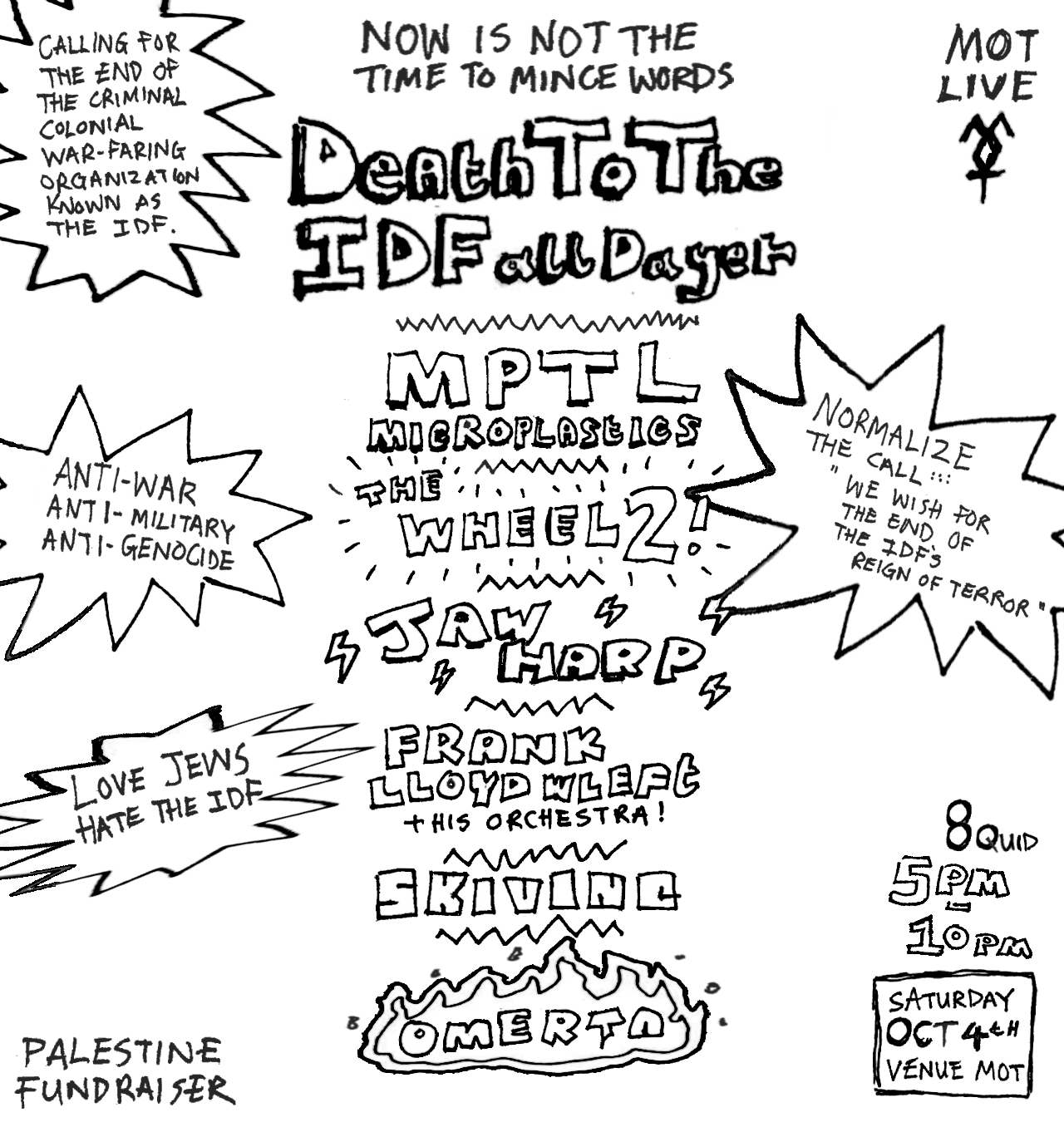
The UK government has now officially recognised the state of Palestine. A ceasefire was recently “agreed” upon – though it was almost immediately broken by the IDF. This has made it clearer than ever that we must continue protesting, fundraising, and fighting for the people of Palestine. Fortunately, James Moss, something of a modern south-east London legend, organised an all-day fundraiser, with all proceeds going to the excellent charity MAP (Medical Aid for Palestinians).
Opening the stacked seven-artist line-up was an impromptu, stripped-back version of The Wheel 2!. This early set kicked off the evening’s experimental wizardry. Despite being a member or two short, the band still conjured the dense, psychedelic noise I remembered from their September performance, when they had a fuller line-up. James once again delivered a chaotic and compelling performance – every vocal line sounding desperate, strained, and brimming with the intensity of John Maus. The band’s eclectic approach went down well, earning a warm reception despite the modest early turnout.
Following The Wheel 2! came Skiving, a band on a rapid upward trajectory. They recently released their single Ich Bin Ein Beginner from their forthcoming debut album The Family Computer. Their set was a joy – a blend of post-punk, spoken-word vocals, and that ever-welcome touch of saxophone. The group played tightly, each member contributing to a distinctive sound that evoked both the angular energy of Gang of Four and the chaotic brilliance of Japanese jazz-punk outfit Midori. Their lyrics, capturing the drudgery and dread of office life, felt like a sharp, cynical reflection of the times.
Next came Omertà, one of the infamous fixtures of the Windmill’s Garage Bashing night – a band defined by their ferocity. Despite a noticeable change in line-up, they unleashed the signature wall of sound they’re known for: an overwhelming, relentless barrage. The chaos extended to the stage banter, as James and Angus traded barbs about nearby Millwall fans in town for a match. Their political edge carried through musically, culminating in a mock “30-second silence for Charlie Kirk” – a noisecore interlude reminiscent of The Gerogerigegege. Total pandemonium. Omertà remain one of those acts that must be experienced live – equal parts terror and exhilaration.
Then came something of a tonal shift via Frank Lloyd Wleft, a modern-day anti-folk figure who has helped shape a new scene alongside acts like Microplastics and David Cronenberg’s Wife. His set was the evening’s calmest moment, offering a much-needed breather after the preceding chaos. His oddball Americana persona felt almost Lynchian – everything a little too polished, too perfect, making it faintly unsettling, and utterly captivating. The highlight came with The Fall of America (Shot on iPhone), a spoken monologue drawn from his track The Actual Kids of America – a hauntingly apt closer that captured the unease of the modern world.
A short intermission followed before the night’s final three acts, during which a speaker addressed how best to support the Palestinian cause. The key messages were clear: boycott, donate if possible, stay informed via trusted sources such as @eyeonpalestine, and show up to protests – even small numbers matter. It was a necessary reminder, one that stayed with the audience long after.
Then came Jawharp, whose set – though brief – was an unrelenting burst of experimental contortionism. They tore through a blistering selection of their most intense tracks, effectively a “greatest hits” set. Their closer, Commemorative Fridge Magnet, was a semi-improvised noise freak-out that became the set’s highlight, with Milligan and Jude tossing their guitars around. Milligan’s final attempt to balance his instrument on his palm before dropping it brought the chaos to a fitting end.
Next up were Dream Slugs, a relatively new duo formed by James Moss and Amelia Blackwell – both veterans of several bands in the same scene. Having caught their debut performance, I knew there was promise, but this time they surpassed expectations entirely. James channelled the manic drumming energy of Lightning Bolt’s Brian Chippendale, while Amelia crafted lush, psychedelic soundscapes using just her guitar and Logic. Together, they pushed the limits of experimental dream pop, proving themselves a duo to watch.
Finally, the headliners: My Pussy Tastes Like Microplastics – the reigning champions of London’s anti-folk underground. I’d long been meaning to see them live, given their reputation for fusing industrial chaos with folk sensibilities. Their self-described “anti-fascist anti-folk” felt like the perfect culmination to an evening devoted to experimentation and solidarity. The eight-piece collective built a cacophonous, near-collapsing wall of sound – a reflection of our turbulent times. Frontperson Joey’s frantic vocals intertwined with the band’s implosive instrumentation, transforming the set into something ritualistic, cathartic, and defiantly alive. A perfect ending to a night that celebrated noise, community, and resistance – all in aid of those who need it most.
Words: Noelle Radewicz