

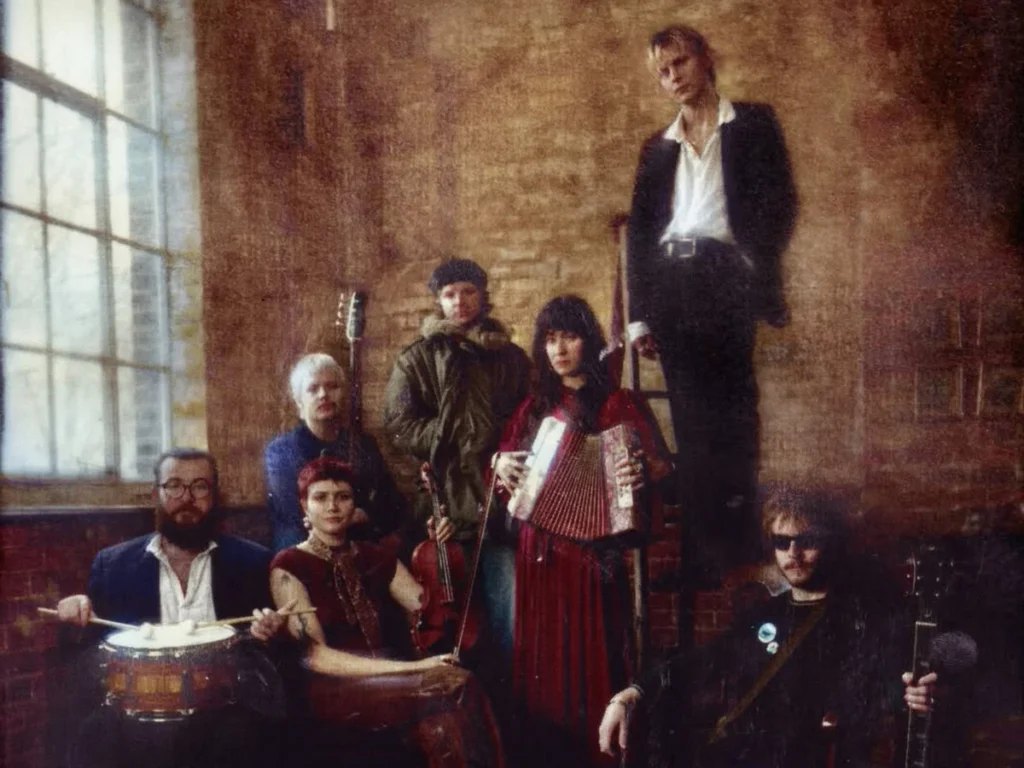
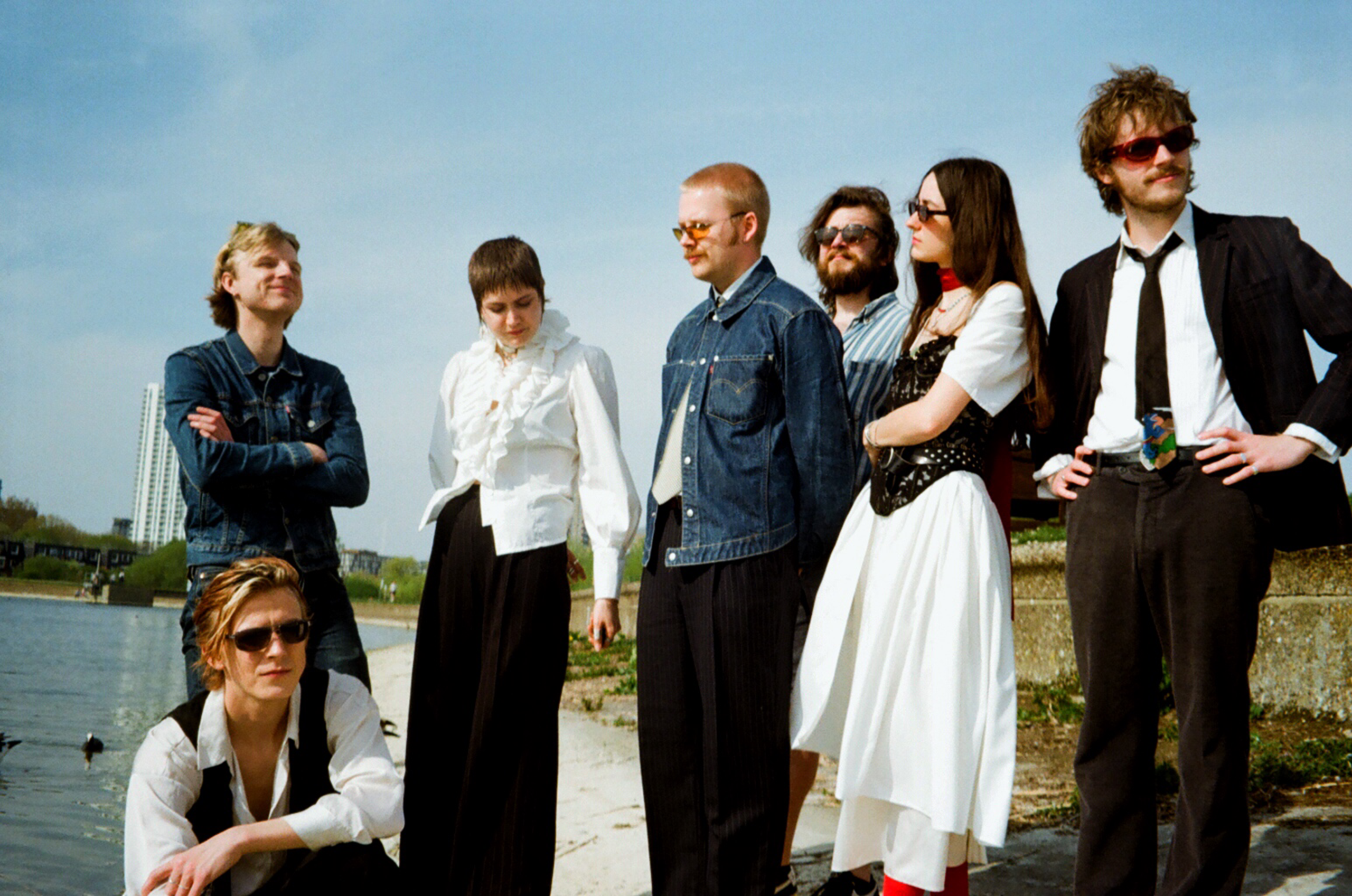
Manchester seven-piece The Slow Country are the latest in a run of Heist or Hit signings from the city’s increasingly fertile scene. Another compelling many-member outfit to add to the list, they marry lucid, anthemic rock structures with a garden of verdant folk instrumentation – a sound that’s earned them a growing buzz in their hometown and beyond. We sat down with Joe Darley (guitarist), Charlie Smith (guitarist), Gina Edwards (keys) and Miren Summers (violin) to talk about everything from getting drunk with Bill Ryder-Jones to avoiding nostalgia, and the best and worst parts of being in a seven-member band.
You recently played your biggest sold-out show yet at St Pancras Old Church. How did that feel, did it register as a milestone?
Joe: It felt really, really good. We’ve been working really hard towards it, and like you said, the biggest show so far so to sell it out was really special.
Miren: It’s such a beautiful venue, really stunning. The crowd engagement was beautiful as well, people were really getting into the music.
What was the first milestone that made you feel like The Slow Country could be something long-term?
Charlie: I think just getting the first gig out of the way and realising we can actually do this.
Joe: And releasing something was a milestone, to be fair, it took us so long to release anything. We were playing and recording for over a year before we released anything. We recorded like three songs and then decided, this isn’t right, this isn’t right, this isn’t right, and then we ended up recording ‘Walking Song’. We settled on that was the right start, the right welcome to the universe. And it was another milestone to see it do quite well, so we’re pleased with that.
Your early shows were mostly in Manchester. How important was that scene and community in shaping you?
Gina: I think we really found our feet in Manchester. Our early gigs, literally all our friends would come to them. They’d always be cheering and everyone was so attentive. So I think that instilled a certain confidence in us to branch out further. Manchester’s music scene is obviously booming now, which is great because there’s so many amazing acts. And even stuff like the Brits being put on in Manchester this year is a big move industry-wise so I think it’s a city that shouldn’t be slept on at all in that way.
You’ve recently signed to Heist or Hit. What drew you to them?
Joe: We’ve known about the label for ages. The work they’ve done over the years with bands from Manchester and Liverpool, like Her’s, Brad Stank, Pizza Girl, Nature TV. Just before we signed, they had Westside Cowboy so lots of peers that we love and artists that we absolutely adore. They’re building something really special which is really great to see.
They’ve got a new A&R guy who’s amazing and is clearly going to a shitload of gigs around Manchester and London. It feels like a privilege, they’re such a kind label, kind people, very artist-first. It’s a real pleasure to be on an expanding, exciting roster. I think it was right, given our connections to Manchester, to sign with a Manchester label.
Was there any hesitation about signing, the idea of losing control?
Gina: I think because they’re an indie label, we knew we weren’t going to lose a lot of autonomy. In the early meetings I had with Zac, the A&R guy, he let me be so forthcoming about who we were and what Slow Country was. I didn’t feel like there was any danger of us losing control over that. It felt quite natural in that sense.
You recorded ‘Firing Line’ with Bill Ryder-Jones. What was that experience like?
Charlie: He’s one of our heroes, every moment was incredibly surreal. You’d just be there thinking I’m going to remember this for the rest of my life because Bill’s music is so important to us. There was a point where he was sat at the piano playing something, recorded a song, and that was just in the room with him watching it, thinking this is absolutely mental.
Miren: He was so engaged with all of us and suggesting things, bouncing off us, really getting into our idea for the music. The collaboration of that process was super nice. It wasn’t just somebody recording us, it was somebody who was building on what we had already and really seeing the vision of it.
Joe: The relationship with you, Mirren, who plays violin, and Bill – he does a lot of film scores and he’s really into producing strings. ‘Firing Line’ initially didn’t have loads of strings in it, and it became this thing where suddenly Bill opened up this song and just added all this emotion into it with Mirren, and it was just really special. You got something unexpected out of the process that we wouldn’t have done if it was just us recording ourselves.
Is that evolution over time typical of your songs?
Charlie: There’s very old songs that go through significant change, and resurface years later for the better and more exciting. Walking Song is a really good example. We played that at some of our first gigs, and then it got shelved for a long time because it was not quite complete. We must have just taken it back to some very presidious writing time. We really delved into it and came out with a very different song. Different structure, it was so different with Mirren’s parts in it as well, and that was quite instrumental to the driving feel of it.
Joe: I think there’s quite a few things where we’ve been playing for so long, we’ve got so many songs that are no longer in our 30-minute set or hour-long set, so it’s kind of like, what about this one we haven’t played in however many years? What happens if we gave this one a new coat of paint? It comes out quite nice sometimes.
After living with songs for so long, is it nerve-wracking to finally release them?
Joe: It’s nice to get music out there in the world, but I wish we did everything much faster. I feel like, as artists, you develop a weird, toxic relationship with your songs sometimes. If you were in a dream world, you could just play them twice in a room and be like, OK, that sounded good, and then if you just released it, that would be fantastic. But by the nature of the industry and being an artist, you’ve really got to plan releases and decide which one’s going to be released when. Everything’s done so far in advance, so it can be difficult sometimes.
What’s the best and worst things about having seven of you in the band?
Charlie: The best thing to me is that I’m a super nervous performer, so even if you’re really nervous and you’re not feeling it, you’ve got six other people to lean on and be there with you. I think just having that is great, I do not know how solo performers do it because I need my friends to be able to do this.
Miren: I think that everybody brings so many skills as well. Every single person is capable of doing at least two different things. Everyone at least plays their instrument and then some people sing as well, Gina can play accordion and keys. There are so many options of skills and things that we could potentially bring to the song or the performance. I think that is really amazing, that gives us so much potential and range.
Downsides, I feel like it’s seven people playing in indie venues. Space is at a premium. We used to be very squished on stage, but that’s fine. We like to be close together. It does mean that when we’re on a stage that’s got plenty of space, it’s like, oh my god, what a luxury.
Gina: Getting everybody together in one place to do things can be a challenge sometimes too but we all care about this so much that we make time to do it.
‘Right There Inside’ is about the dangers of nostalgia. Do you try to avoid looking back too much as a band?
Charlie: I think as a band it’s so important to just keep looking forward and keep, as much as things that we’ve done before are great, I’m always in my head thinking that we’ve got to be improving. As long as things are improving, I think it’s always good.
Joe: I feel like we always look back on things. It’s important to look back on things, I think, to take it in and appreciate it. But it is very easy to just think about the past too much. There’s a balance really between the two.
Miren: When we have an idea we try to just do it, just put it out there. Don’t get so wrapped up in it and like, oh, what could this be? Maybe we should try and do this. Just keep moving forward, keep trying things. Don’t get too bogged down in things. It’s difficult to do, obviously. You can have a lot of protection around your creativity and your art, but you have to remind yourself of that if you’re doing any kind of creativity.
You’ve worked with fashion designer Rabbit Baby, you’ve also got some cool artwork and music videos. How important is the visual element to what you do?
Joe: It’s really important. It’s so much of an intertwined world, especially in this modern era. It’s how everyone digests something through both mediums, sonically and visually. To have a brand and an identity that people can see and know that that’s one of Charlie’s great drawings or that’s some of Charlie’s posters, etc. Our work we do with Hugo, who’s done every single so far. That continuity and that sense of identity in everything that we do. It’s so important to have that theme and current flowing through everything else, visually.
Miren: I think it was part of what made the St Pancras Old Church gig really special. I was waxing lyrical about it to people for ages about the lyric books and having that really personal touch to having each of the illustrations on the pages related to the songs that we were going to play on the set. So many people who came along came away with that and were like, this is so good, I’m going to treasure this. That visual element, that connection between the physical art and the experience of musical art is something that’s really special and you want to be able to create.
Beyond music and art, what else feeds into your work?
Charlie: Films are a really big influence and TV as well. Lyrically, I think they’re really big factors to me anyway that influence me. When life isn’t that interesting, you can turn to films and TV and pull from them. I think our music as well, to me it feels quite cinematic and I think always having them things in mind when writing songs.
Joe: Some of the songs are quite story driven as well, which seems to relate to film in that way, that cinematic world. We’re not exactly a political band, we don’t sing too much about how shit modern life is but drawing from something else, something a bit more of a scene.
Gina: I think if you watch something and it truly strikes a chord within you, then it’s so nice to be able to write about that. One of the songs we’re playing tonight is called ‘Black Dogs Howl’, and I wrote the lyrics to it after watching True Detective, because I was absolutely mesmerised by it. But it’s nice to know that I’ve written about that, but someone might have a different meaning in the lyrics. It’s very layered.
Miren: I think that the music video that we brought out for Amy Stew goes so well with the song that Lara Fullalove directed. I remember watching it for the first time with everyone, and there was this moment where the song breaks, and everyone was like, oh my god, I cried in that moment. The combination of that music video and her direction, with the nostalgia and the combination of the new and the old, just worked really well together.
It’s been nearly a year since you released ‘Right There Inside’ – what’s changed since then?
Gina: More confidence. I feel like we’ve got a bit of bollocks now.
Joe: There’s like big crowd vocals to that song and I think now we’re so comfortable with it and getting behind it and everybody singing. It took a lot to wrangle Finn, our bass player, and James, the guitarist, to actually get them to sing the song. And recently the church show, Jackson Roy, who plays saxophone on that song on the recording, we finally got to have him play on it and that was just really special. It’s probably our most communal of songs so having him there was really special.
Gina: It’s such a fun song to play. At the church show, people were singing it back to us – that really touched something within me, but I feel our songwriting is ever-evolving. So I feel like it’s the same but different.
Where would you like The Slow Country to be a year from now?
Joe: World domination. Big in Japan.
Gina: I think we would really love to get a great tour support slot, get on some really good festival line-ups. Release more music, keep your ear to the ground.
Charlie: End of the Road festival, that’s a big dream of ours. We’re trying so hard to make that happen, we go there every year. That’s the goal for next year.
Words by Donovan Livesey