
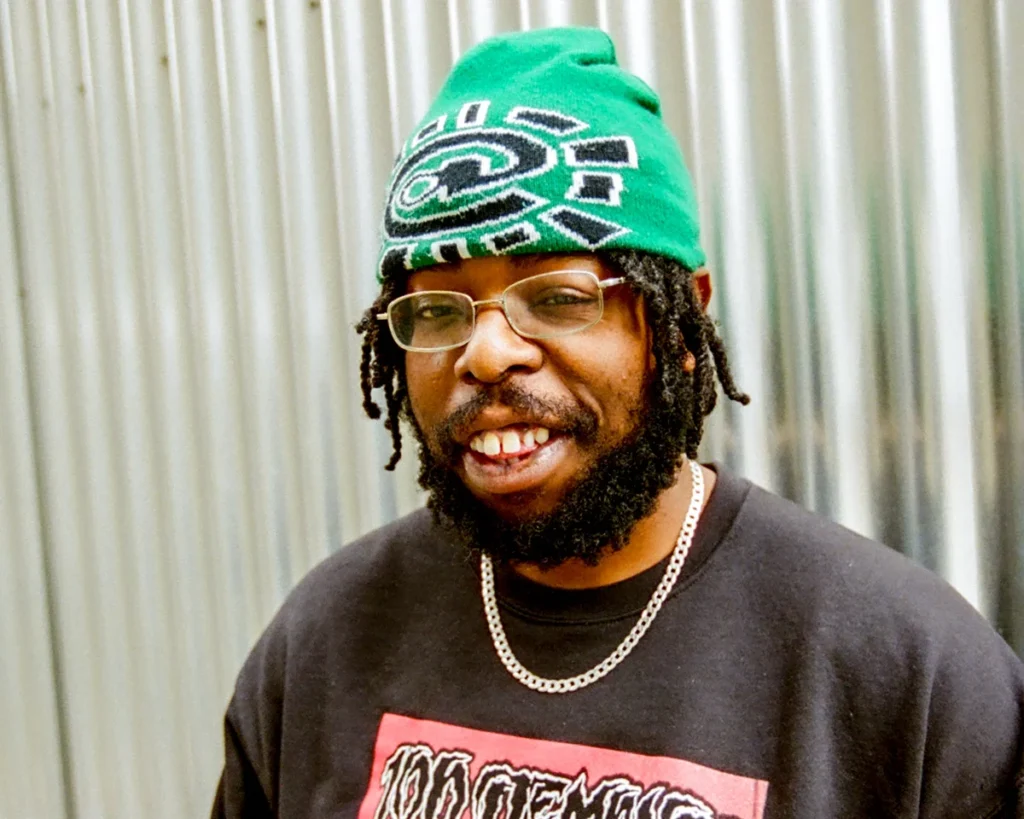
Birmingham rapper/producer/guitarist/label-head Tony Bontana is a great British one-off. Ridiculously prolific, he’s a restless creative with 60 records on Bandcamp, switching between genres as his mood takes him. Usually he’s a rapper drawn to classic hip-hop beats, but at other times he’s the frontman of a hardcore band, or making experimental music bordering on free jazz. It’s a freedom enabled largely by operating outside the usual industry structures, releasing everything through his own label, Everything Is Perfect, which he co-created eight years ago. Following the release of his biggest album yet, ‘My Name’, we caught him before heading out on tour with Dry Cleaning to talk about everything from Birmingham’s “underdog” mentality to staying independent and getting more Black kids into alternative spaces.
You’re obviously from Birmingham. What was the scene like there when you were growing up and now, and what are some of the biggest barriers artists face in Birmingham?
Growing up, I wouldn’t say it was a huge scene but there was definitely a healthy hip hop scene. There was a group called The Odyssey which was four people. There was a guy called Joe Caulfield who’s still an artist now, a guy called Sigmund who plays in a band called Keg and lives in London at the moment. There’s a guy called Shake, he’s one of them guys that’s had loads of different names, but he’s dropping an album with the label actually in a moment’s time. And then there’s a guy called Dan Odyssey and those four guys as a group were at the forefront of the hip hop scene in Brum.
I was heavily into a lot of hardcore punk scene as well at that time. There was actually a lot going on in Brum but I feel like on a wider scale, it was kind of insulated to the city, things didn’t really get outside of the city so that’s always kind of been a bit of a barrier for artists in Brum, but I feel like that’s starting to change a bit now, which is cool.
How do you think growing up in Birmingham shaped you as an artist, and do you think your approach or style would be different if you grew up somewhere like London?
Yeah, 100%. I think a lot of people from Brum, we’ve kind of got this underdog kind of vibe where I feel like we just got to work a little bit harder, or at least that’s how it feels when you’re here. So I think that kind of plays heavily into the way I work and release music – obviously I release quite a lot of music and I feel like that’s part of being from here. It definitely makes me who I am as an artist and as a person.
You still live in Birmingham. Obviously a lot of artists move to London for the opportunities and stuff, so what makes you want to stay true to it?
Because I’ve seen so many people do that. I’ve seen so many people do that, and to be honest I see a lot of people change once they get to London – I think it’s one of them things that can’t be helped. I spend a decent amount of time in London so I see what it’s like and I see how that environment can alter a person, and that’s something that I’ve kind of wanted to stay away from. I’ve wanted to stay connected to my roots.
On ‘My Name’, there’s a lot of really local, working class references, like on Battered Chips. What made you want to include all those hyper-local references?
Over the past few years I’ve been thinking a lot about UK music’s identity. I like a lot of underground music but I’ve kind of noticed that a lot of sounds are kind of merging into one type of thing, whereas when I was growing up the localised sounds were the thing that drew me to different types of artists. I wanted to put more of a focus on what makes me me and what makes Birmingham Birmingham and what makes Birmingham music Birmingham music type of thing. As much as I obviously get influenced by sounds from all over the place, I want to have a piece of where I’m from in the music at all times.
You’ve got the localised sounds, but the album’s got popularity worldwide. Did that surprise you at all when you were singing about like battered chips in a Birmingham accent, but people around the world are loving it?
It does make me laugh to be honest. I think that song in particular, I think a lot of people have kind of gravitated towards that, or maybe it’s the first time they’ve kind of heard about that. But I think it’s cool and I think that kind of furthers my point about the importance of putting where you’re from in your music because it brings people to that place. And like I was saying earlier about the struggles that Birmingham artists have, I feel like the more attention that can bring to that and what we’ve got going on here, it’s kind of better for everyone really.
It reminds me of The Streets, because the songs are so distinctly British but they’re loved around the world. I guess no matter where people are from, they just want authentic stuff, which is the same with you…
100%. I was actually watching a thing the other day at home, it was a guy that used to work with Mike Skinner and he was saying that he met RZA from Wu-Tang, and RZA was like, Mike’s the best. And bearing in mind Mike’s written about these very Birmingham type of things, so I 100% agree with that. I think when people can hear where you’re from and the differences from that to everything else that’s kind of out, that’s a superpower, I think.
On the latest album, you move between rap, punk, hardcore, grunge, jazz. Do you see those as separate worlds or one continuous expression? How do you balance them?
With the band Pay The Stranger, it is all under the same umbrella because I’m writing all the music, but I do like to put different hats on at different sides and I think that’s how I’m able to keep things going. When I just do the Tony stuff, I’ll work for a certain amount of time then I’ll want to do something else, so then I can do Pay The Stranger and then if I get bored of that, I can make some jungle and do some DJ Bloody Mane stuff. But I do want to keep an element of everything under one umbrella because I like all these different parts of music, so I never want to box the Tony Bontana project into a certain type of hip hop. I’ve got some plans for later this year to release some real left field shit.
Journalists are often trying to pin down your genre, but do you think those boundaries are less relevant now? It feels more free with your music.
I feel like people are always low key going to do that, it’s not something that bothers me much. Some people it really bothers, but as human beings, people are always trying to understand things so that’s how these different categorisations come about. Obviously I push this whole ‘splayed’ stuff because that to me is a real specific sound that we’re building on, but it’s more of a philosophy of taking something and making it into something else in an art sense.
You’ve said that you do the punk and hardcore stuff to show black kids it’s alright to be in those circles. It does feel like the alternative scene is mostly white-dominated, so what do you think needs to change for that to shift?
I feel like it’s about actually showing up, because when I was going to punk and hardcore shows when I was younger, I was the only black kid there. But then as I’ve kept going, kept showing my face, you start to see more and more people turn up, more bands starting and stuff like that. So I think it’s just about getting over that first hump of actually turning up, and then also sharing that with other people. I think being there is the most important thing – when people can see, oh shit, there’s someone else that looks like me here, it just makes you feel a bit more comfortable.
Did you ever feel out of place in those spaces?
Yeah, to a degree. But I think I just had to get over that because at the end of the day, I was there because I enjoyed the music and I wanted to see it live. I think if you enjoy something you should go and support it in real life. Streaming something or watching something on YouTube is one thing, but actually getting out of your house and going to experience that and share that with other people is, I think, the most important thing.
‘My Name’ was your first album to get a vinyl release. What did it feel like to hear your music on a record player for the first time, and how important is that physical element to you?
It was mad important to me. I love vinyl. I’ve been collecting vinyl for nearly 10 years now, I’ve got quite a big collection so having one of my own projects on vinyl was always a bucket list goal I was working towards. To be able to do it on this album, which has felt like quite a special project – it’s got a lot more attention and a lot of press and stuff – for it to be this one in particular was mad important to me. I’m gassed to have it out there.
You obviously started your own label as well, Everything’s Perfect. How did that come about and what made you want to do that?
So that was me and Sink600, who’s someone that helps me with the label, and he’s an artist as well. We started making this sound, which we called Splayed, and basically thought we’d start our own thing instead of trying to find someone else to put stuff out. Then that snowballed into a lot of friends wanting to release with us, and then that snowballed into putting on shows and doing the whole Splayed World event. I guess it’s just the freedom to do what we want when we want, without having to run it by people or having any constraints about what things have to sound or look like. I think it’s just that element of freedom to our art.
The label’s been about since 2018, and you’re still releasing your stuff on it now. What makes you want to keep doing that instead of moving to a bigger label? Is it about keeping that agency?
Yeah, 100%. And also because I still want to release my friends’ music, and the more popular my stuff gets, the more popular the label gets, so that means more attention will be on the other artists that release with the label. For some of them it’s the first thing they’ve ever released, like this band from Ireland called Some Images of Paradise who released their first EP with us two years ago, and they just dropped their debut album last year and that has gone absolutely crazy for them. They’ve had some crazy co-signs, crazy tours, and they’ve been able to elevate things, and I’d like to think the label’s played a part in that. So to be able to keep raising that and raising the stakes for everyone involved is something that I want to continue to do.
There’s like 60 records on your Bandcamp. What draws you to releasing so much music at that pace, and what do you think you gain from releasing so much music that artists who overthink it might miss?
Releasing the way I do is, for one, just kind of natural to me. When I feel like something’s finished, I’m happy to let it out that day, whereas I think a lot of other people will finish it and then make more and more and have this whole long plan about doing this, this, and this. As much as that works for some people, I think the immediacy is just what comes naturally to me. But the plus side is that people who are a fan of my music can kind of come on this journey with me.
With each project, I like to think people can hear things getting better, whether it be my verses, my bars, my production, or the mixing and mastering, because I mix and master my own things as well. So I feel like people that are invested in my work are literally coming on this journey with me and they can hear how we level it up each time. I feel like my connection with my supporters is real strong – a lot of people that mess with my music have been messing with my music for years. It’s not quick, oh I found this guy go viral last week on TikTok, it’s like I’ve been invested in this guy for four, five years and I want to keep building that.
You released a single with Max Winter recently. How did that come about and what was he like to work with?
I met Max on a tour with Nourished by Time – he played guitar for their live band in Europe – and we just hit it off. Max is a really cool guy. We kind of had ideas to work with each other and then he sent me the instrumental for a track, which on its own sounded mad. The cover for the single was my actual email response to the instrumental. I sent it back within like a week, it was one of them where it kind of flowed out naturally, which are the best ones. And from there, he got a drummer, a sax player and some others to build on what we already had as a basis, and then put it all together. We actually recorded the video at the start of my tour – he came and met me in London and we went near Tower Bridge and jumped for about two hours.
You’re playing Green Man this year, which is your first UK festival. How are you feeling for that, and do you think you’ll approach it differently to a headline show?
I’m excited about it, for sure. I’ve never been to that festival but a lot of my friends say that’s one of their favourite festivals in the UK, so I’m definitely excited for it. But I think the way I approach live shows, whether it’s a support slot or a headline, I approach it the same way and that’s just to put it all on the stage and try and get as many people involved as possible. I really like crowd participation and shit, so I think those festivals and those bigger stages are going to be really fun. That’s one of my favourite parts about making music – obviously I love making music, but I really love performing and putting on a show.
It’s nearly seven years since you released your debut album Tony Tape. What do you think you’ve learnt in that time, how have you developed and what’s changed?
Yo, so much man, so much. I think life is the biggest teacher, lowkey. I think I’ve learnt to listen more. The older I get, the more that I learn that just stopping and listening is the most important thing and how you learn the most. But also so much technical stuff when it comes to mixing and mastering – the stuff I release now sounds miles and miles better than how the early stuff sounded. But I like that because people can hear what it was then and what it is now.
What do you want to achieve with Tony Bontana? Are there any main indicators of success?
Just to elevate, to continue getting more in tune with myself and in turn more in tune with the music I’m releasing. I want to make music that I want to listen to when I’m travelling, when I’m living life – I think that’s my main goal, to make the music that I want to hear. I just want to continue doing that and make sure the people that support me are well fed.
Words by Donovan Livesey